Showing posts with label Guided Tour Available. Show all posts

Ormond Castle, County Tipperary


If you’d like to receive daily updates about great heritage sites then please consider following us on Facebook, Twitter and Google+.

Ormond Castle in Carrick-on-Suir, County Tipperary, originally dates to the fourteenth century. It is named after the Butler family, a highly influential and powerful Norman dynasty who became Earls of Ormond. The progenitor of the family in Ireland was Theobald Walter who came to Ireland in the aftermath of the Norman Invasion in the late twelfth-century. He was rewarded for his service by being granted vast lands in the South-East of Ireland, particularly centred around Counties Tipperary, Kilkenny and parts of Waterford. He was also given the title Chief Butler of Ireland, who had the honour of personally serving the King on state occasions, and with this came the right to levy his own tax on all wine imports into Ireland – as the Normans were known to like a tipple this ensured that Theobald Walter and his successors became very wealthy indeed!

In 1315 Edmund FitzWalter (6th Chief Butler) was granted the Lordship and Manor of Carrick by King Edward II, and his son James made the advantageous marriage to Eleanor de Bohun, a granddaughter of the King. By the middle of the fourteenth century, the Butlers were Earls of Ormond and had cemented their position as one of the wealthiest and most powerful dynasties in Ireland.

The castle at Carrick-on-Suir is thought to have an early origin, but the remains visible today largely date to later than the fourteenth century. In the grounds you can see the ruins of a medieval bawn (a fortified walled enclosure), with two tall fourteenth or fifteenth century towers. One of the towers is in ruins, while the other tower (thought to be the earliest of the two) is still well-preserved. If you look closely at the ruined tower you can still see features like the ornate fireplace that probably dates to the fifteenth or early sixteenth century [a noisy family of ravens have made one of these towers their home, and their calls certainly add atmosphere to the site]. Other buildings in the area exist only at foundation level, though it is possible to see the remains of the large bricked up Water Gate in the exterior wall. In the medieval period, the River Suir flowed at the base of the castle walls, and the River Gate allowed goods and people to be transported easily up and down the River to the other major centres nearby at Cahir, Clonmel and Waterford.

The Tudor Period was a turbulent time in Irish history. An uprising by the Butler’s long time rivals, The Fitzgeralds, had just been defeated, and King Henry VIII had become the first English Monarch to declare himself ‘King of Ireland’. He began a process of plantations and conquest that was continued after his death, during the reigns of Mary and then Elizabeth. During this chaotic period, Thomas Butler, Earl of Ossory and 10th Earl of Ormond succeeded to his lands and titles in 1546 when he was just fifteen years old. Thomas had grown up at the English Court, and was seen as a faithful friend to the Crown. He was a personal friend to the young Elizabeth (and some suggest perhaps their friendship was more romantic than platonic) and he shared a tutor with the future King Edward VI. Following King Henry VIII’s death, Thomas Butler was present at the Coronation of the young King Edward and he was proclaimed as a Knight of the Order of Bath, a very high honour. Following Edward’s death at a young age, he remained at court during Mary’s reign and rose to high favour and prominence when Elizabeth became Queen. She named him Lord Treasurer of Ireland, a position that brought great wealth and prestige. 

He returned to Ireland, where he was thought of favourably, though he was considered to be ‘wholly English’ by the locals. He fought a number of bloody campaigns against the rebellious O’Moore’s of County Laois. However, despite occasionally earning the displeasure of the English Court due to ongoing feuding with the Fitzgeralds, Thomas [or Black Tom as he became known] maintained the good favour of the Crown. He was awarded a number of titles; President of Munster, Lord High Marshal of Ireland and Commander in Chief of Her Majesty’s Forces in Ireland.

It is said that he had the handsome Manor House of Ormond Castle constructed in preparation for a planned visit by Queen Elizabeth the Ist. However she never journeyed to Ireland to see this splendid building. This building is Ireland’s finest surviving example of an Elizabethan Manor House, and many of its architectural styles reflect the English influence. Originally, its handsome stone walls would have been covered with a plaster render and whitewashed in the fashion of the time. The building faces outwards onto what would have been a large park with a grand carriageway.
Today you can enjoy a guided tour around this building (though unfortunately no interior photographs are permitted). You can enter a number of the rooms, most impressively the Long Gallery, and you’ll encounter features like musket-loops, showing a formidable defensive, as well as fashionable, design. There are a number of pieces of period furniture, though none are original to the building. They do give a good sense of the style and furniture of the period. Perhaps most impressive of all is the rare plaster stucco friezes that depict the coat of arms of the Butler Family as well as griffins, falcons and portrait busts of Elizabeth Ist. You can also see impressive grand fireplaces in this stately room that once would have been filled with portraits and tapestries, leaving visitors to Ormond Castle in no doubt about the wealth and taste of the Earl of Ormond.
Facing towards the now blocked up arch of the Water Gate

Gradually the Butler family began to focus their attention and money on their other residences at Kilkenny Castle and Dunmore House. By the end of the seventeenth century, Ormond Castle was leased to tenants like Sir Ralph Freeman and his wife, and a group of French merchant families. A number of changes and alterations are believed to have been carried out at this time. In the eighteenth century, a solicitor named Mr Wogan who was a tenant at the castle levelled many of the ancillary buildings and began to modernise the Manor House. Gradually, Ormond Castle began to fall into disrepair. It was taken into OPW care in the 1940s, and a long programme of restoration was initiated.

The Castle is open free of charge to visitors daily from; 6th March - 2nd September. Access to the interior is by guided tour only, and I strongly recommend you take the fascinating tour to see the impressive long gallery, and to get a sense of life in Tudor period Ireland. For more information please see http://www.heritageireland.ie/en/South-East/OrmondCastle/. The site is one of the key stops along The Butler Trail, a great new initiative. Please see here for more information: http://www.discoverireland.ie/thebutlertrail


Thank you for taking the time to read our blog, if you’d like to support us please consider downloading one of our acclaimed series of audioguides to Ireland’s heritage sites, they are packed with original music and sound effects and a really fun and immersive way of exploring Ireland’s past. They are available from AbartaAudioGuides.com.

If you’d like to receive daily updates about great heritage sites then please consider following us on Facebook, Twitter and Google+.


All photographs © Neil Jackman /abartaaudioguides.com

Lough Gur, County Limerick


If you enjoy our blog posts and would like to see daily pictures and information about Irish archaeology, history and heritage please follow us on Facebook, Twitter, Google+ and Instagram

Lough Gur in County Limerick is one of the most important and remarkable archaeological landscapes in Ireland. This small, horseshoe shaped lake has been surrounded by human settlements and activity going back over 5,000 years ago to the first farmers in the Neolithic period, though it is likely that this area was occupied even earlier, during the Mesolithic, though as yet no archaeological evidence has been found dating to this period.

The site is possibly most famous for its Neolithic settlement. Several houses, forming a small village, have been excavated on the south-facing slopes of the Knockadoon peninsula, which extends out into the lake. Both rectangular and circular houses were discovered. They were constructed by driving double rows of posts in 1m apart, these posts supported a hipped roof and screens made from woven hazel rods known as wattle. The screens were covered in daub, a mix of dung, clay and straw which when dried, would have been an effective breathable, but water and draft-proof, wall. The houses may have been insulated with a layer of earth sods, reeds or straw. An example of one of the rectangular buildings and a circular building have been reconstructed and now serve as Lough Gur’s Interpretation Centre.  


The Centre itself is very well laid out, with great information on the archaeology, history and folklore of Lough Gur. It has a number of superb reproductions of the incredible artefacts discovered at Lough Gur, and has informative interactive panels and exhibits making it fun for all ages. The visitor centre is an essential introduction to the complexity of archaeology in the region.


The foundations of an early medieval structure and field systems at the 'Spectacles'
From the Visitor Centre, your first stop will be a lovely walk that takes you past ‘The Spectacles’ where you can see the foundations of a number of buildings and field systems dating to the early medieval period. As you follow the path beyond the Spectacles, you climb ever higher and get spectacular views over Lough Gur. From here you can see the castles built by the Earls of Desmond in the later medieval period, and the earlier crannogs, small artificial islands, on the lake.
The foundations of one of the circular stone built ringforts (or cashels) at Carraig Aille

When you have finished your visit to Knockadoon, a short drive up the road will bring you to the cashels of Carraig Áille. These well-preserved early medieval stone ringforts have quite spectacular views, and are well worth the short climb up a hill. I will be featuring these forts in their own forthcoming blogpost.

The Lough Gur Wedge Tomb
 Another short drive from Carraig Áille and you can find a wonderful example of an Early Bronze Age wedge tomb, similar (though smaller) to that of Labbacallee in County Cork. Again, I will feature this tomb in it’s own blogpost as it is a fantastic site in its own right.

 
The lovely and peaceful Teampall Nua

Our next stop again just minutes along the road was the church ‘Teampall Nua’. This church is thought to date to the seventeenth century (though some architectural features look more medieval to me). It replaced an older chapel used by the Earls of Desmond.


Our final stop was Grange Stone Circle located just on the west of the lake and very easily accessible from the Limerick–Killmallock Road (R512). This stone circle is just incredible, it  is massive measuring nearly 50m in diameter. It is a near perfect ring of 113 contiguous stones (all the stones are touching). The entrance is marked with the tallest stones that are mirrored on the opposite side of the circle, apparently forming an alignment with the midsummer moon. The site is spectacular and will certainly feature in a separate blog post.
As an archaeologist I found the visit to Lough Gur to be almost like a pilgrimage. It is such a beautiful part of the country, and our visit barely scratched the surface of the sheer wealth of archaeological and historical sites clustered around the lake. A visit to Lough Gur is an absolute must for anyone with an interest in archaeology and history! You can find more information on Lough Gur from their website at http://www.loughgur.com/


If you have a suggestion for a site I’d love to hear it, please let us know by dropping us a line at info@abartaaudioguides.com or on Facebook, Twitter or Google+, where you can keep up with daily pictures and information about Ireland's wonderful heritage sites.

If you'd like to support us please consider downloading one of our audioguides from www.abartaaudioguides.com, they are packed with great facts, information, stories and legends from Ireland's iconic sites. They are designed to be fun and informative whether you are visiting the sites or from the comfort of your own home, so if you are looking to escape to the Court of Brian Boru the next time you are doing household chores download one of our guides and let us whisk you off to ancient Ireland!


Reginald's Tower, County Waterford

Reginald's Tower
Reginald’s Tower was once described by the famous Irish patriot Thomas Francis Meagher  in 1843 as being “a massive hinge of stone connecting the two great outspread wings, the Quay and the Mall within which lay the body of the city", Reginald's Tower is one of the finest surviving examples of medieval urban defence in Ireland.


The story of Reginald's Tower begins with the Viking adventurer Regnall who constructed a defensive base [known as a Longphort] where the tower stands today. Regnall was the grandson of the feared Ivor the Boneless, and by establishing his longphort at Waterford he created the foundations for Ireland’s first city. It quickly developed into an important trading hub, and Waterford become a vital part in an expansive trading network that connected it to far flung and exotic places like Baghdad, Greenland, Russia and Byzantium.

Access to each level is via the spiral staircase
Waterford grew in wealth and prestige, and gradually the Viking raiders became entwined with the Gaelic Irish population through alliances and marriage, forming a culture known to historians and archaeologists today as the Hiberno-Norse. The peace of Waterford was not to last though, the city was taken following a siege by the Anglo-Normans in 1170 after many of the Waterford men were slaughtered after falling into Raymond le Gros’s cunning trap at nearby Baginbun in County Wexford (click here for that story). The Normans held the leaders of the city in Reginald’s Tower, but released them following an intervention by their Irish ally, Diarmaid MacMurrough, King of Leinster. The leader of the Normans, Richard de Clare (known as Strongbow) married King Diarmaid’s daughter Aoife in Christchurch Cathedral in Waterford, strengthening the alliance between the Norman invaders and the Irish kingdom of Leinster.


The elaborate roof of the Tower
The Hiberno-Norse warriors that survived were expelled from Waterford, but rose in a bloody rebellion in 1174, forcing the Norman nobles and garrison to take shelter in Reginald’s Tower, where they managed to repel the attack and following reinforcement they took back the city. King Henry II in England had began to worry that Strongbow was becoming altogether too powerful and big for his boots, so he sailed into Waterford in 1171 and declared the wealthy Waterford to be a ‘Royal City’, thus denying its lucrative trade to Strongbow. King Henry had the city refortified in the early thirteenth century, and it is likely that it was at this time that the wooden fort of Reginald’s Tower was reconstructed in stone. He had large stone walls constructed to surround and protect the city with a number of defensive gateways and towers added. Very little of these walls still survive today, and of the seventeen defensive towers that once protected Waterford only six still survive, with Reginald’s Tower being the most impressive and best preserved.

 Reginald’s Tower was again at the centre of the action in 1495, Perkin Warbeck a pretender to the English Crown, sailed up the River Suir and began to bombard Waterford to force it to surrender. The people of Waterford retaliated by firing cannon from Reginald’s Tower and succeeded in sinking one of Warbeck’s ships, defending the city with such ferocity that Warbeck retreated. In recognition of the determined bravery by the people of Waterford, King Henry VII gave Waterford the motto: 'Urbs Intacta Manet Waterfordia' – Waterford remains the Untaken City.

However the Tower is not without its scars, and if you look high on the tower to the right hand side of the entrance you can see a cannonball deeply embedded into the stone. This was fired during the Parliamentary siege in 1650.
Cannonball embedded in the walls of Reginald's Tower
They had returned to capture Waterford after Cromwell had failed to do so in 1649, Waterford was the last Irish city east of the Shannon to fall to Cromwell’s forces.
Today visiting Reginald’s Tower you can become steeped in all of this history, and see the variety of ways that Reginald’s Tower has served Waterford over the centuries, from being a defensive bastion, a coin mint, an armoury and arsenal, a prison and the home of the High Constable of the city.


It is split over four floors connected by a medieval style spiral staircase, with displays on different aspects of the buildings history on each level. There are some really interesting artefacts on display, as a dog owner I was touched by the beautifully intricate copper-alloy dog collar dating all the way back to the twelfth century.
The 12th Century copper-alloy dog collar
Reginald’s Tower is a truly iconic landmark of Waterford, and today the superb museum is certainly worth a visit! It is under the auspices of the Office of Public Works, you can find information about opening hours, entry fees and accessibility here http://www.heritageireland.ie/en/South-East/ReginaldsTower/. It is one of remarkable Waterford Treasures, along with the Medieval Museum and Georgian Museum that make Waterford such a wonderfully historic and fun city to visit. You can find more information on the Waterford Treasures here http://www.waterfordtreasures.com/.

I really hope you enjoy our blog posts. If you’d like to consider supporting us you can do so by downloading one of our audioguides. They are narrated by professional actors, and have original music by talented musician Enda Seery to help immerse you in the story. They generally run for around 45mins and can be downloaded from our website at www.abartaaudioguides.com. A number are available free of charge and others cost just €1.99, so if you’d like to hear the story of Glendalough, or what life in Dublin was like when it was a Viking Longphort please do try our guides.

If you’d like to keep up with daily posts about Irish heritage then you can find us on Facebook, Twitter and Google+. If you have any suggestions about great sites to visit I'd love to hear from you, please leave a comment below or you can email us at
info@abartaaudioguides.com.

We are absolutely delighted to have made the Long List for the prestigious Blog Awards Ireland 2013 in four categories: Best Newcomer, Best Blog of a SME Business, Best Arts and Culture Blog and Best Photography Blog. We're up against some very strong competition in each category, check out the Blog Awards website http://www.blogawardsireland.com to discover the wealth of talent of Irish Bloggers and the sheer variety of subjects!

Ashbrook House, County Derry

The Entrance Hall of Ashbrook House
During our stay in the beautiful Faughan Valley County Derry we had the opportunity to take a tour of Ashbrook House. Situated in 30 acres of mature parkland, Ashbrook House has been the home of the Ash family since before the Plantations of Ulster. We were given a great tour by Melanie, whose family first built the house in the late-sixteenth century.


The Estate was said to be a gift from Queen Elizabeth I to General Thomas Ash for his services during the Nine Years War in Ireland. The war raged from 1594 – 1603, when the great Earls of Ulster Hugh O’Neill and Hugh O’Donnell rose in rebellion against the English control of Ireland. This war was to be the biggest conflict fought by England during Elizabeth’s reign with more than 18,000 troops engaged at the height of the conflict. Despite initial successes for the Irish forces at the Battle of the Yellow Ford, the war eventually came to an end following the Battle of Kinsale which was a decisive victory for the English forces, and led to the Flight of the Earls. Hugh O’Neill, Rory O’Donnell and about 90 other followers fled Ireland. This is seen as a pivotal moment in Irish history. The Earls believed that they were going to return at the head of a large continental army to secure Irish independence, however this was not to be the case. Hugh O’Neill died within a few short years of his exile, and Spain and England secured a peace treaty. Gradually the Gaelic order of life in Ireland began to disintegrate and the plantations of Ireland, particularly the Ulster plantations, continued unhindered.
The front of the house
The Ash family have been entwined in the history of the region. During the Siege of Derry in 1689 Ashbrook was partially burned by King James soldiers as the Ash family were loyal to King William and were besieged in the city. It was Captain Thomas Ash who wrote the most widely accepted diary of the events of the siege, and it was his sister Jane who married Captain Browning who commanded the fleet that famously relieved the starving city and broke the siege.

The house is a two-storey, bow fronted house and the oldest part of the house is thought to date to the late sixteenth century, you can notice the older parts of the structure by the low ceilings and much thicker walls. Entering through the grand entrance hallway you’ll quickly notice that the house is steeped in the families history and everywhere you look there are portraits, artefacts and mementos that tell a thousand stories and tales of the Beresford-Ash family. Melanie told us some of these tales and it was a fun and fascinating journey through her families history, it is no exaggeration to say that you could easily spend days just looking at all the different pieces of furniture, items or paintings that fill the house, it is an absolute feast for the eyes! We had the opportunity to see numerous rooms, each with its own character and stories – it was a truly fascinating way to spend a morning. If you are visiting Derry then do make an appointment to visit Ashbrook, this beautiful historical house makes a lovely counterbalance to the thriving and bustling city, I highly recommend a visit!

You can find out more about Ashbrook and book a tour by visiting their website http://www.ashbrookestate.com/ and they have great Facebook and Twitter accounts too that are well worth a follow to see great pictures and info about this beautiful house.

While you are visiting Ashbrook do drop in to the lovely Beech Hill Country House for a walk around their beautiful grounds to discover where the US Marines were based during WWII and you can enjoy some gorgeous food! For more information about the lovely Faughan Valley and to find accommodation please visit http://www.discoverfaughanvalley.com/


I hope you enjoy our blog, if anyone has any suggestions for places to visit I’d love to hear them. Please leave a comment below or find us on Twitter, Facebook or Google+.

If you’d like to consider supporting us you can do so by downloading one of our audioguides. They are narrated by professional actors, and contain original music by talented musician Enda Seery to help immerse you in the story. They generally run for around 45mins and can be downloaded from our website at www.abartaaudioguides.com. A number are available free of charge and others cost just €1.99, so if you’d like to hear the story of Glendalough, or what life in Dublin was like when it was a Viking Longphort please do try our guides.
Ashbrook House from the air

Tintern Abbey, County Wexford

Tintern Abbey was said to have been founded in 1200 when the powerful Norman knight William Marshal set out to pay his first visit to Ireland after his inheritance as Lord of Leinster. However his ship was struck by a storm off the east coast and was close to foundering. He vowed to God that if he safely reached the shore he would found an abbey wherever he landed. He managed to get ashore at Bannow Bay in County Wexford, and Marshal kept his vow, granting 3500 hectares to the Cistercian order to establish an abbey. Hence why Tintern was occasionally called 'Tintern de Voto' or 'Tintern of the Vow'. As the Earl of Pembroke, William Marshall was also the patron of Tintern Abbey in Monmouthshire in Wales, he brought monks from the Tintern in Monmouthshire to settle in his new foundation in Wexford, which they also named Tintern in honour of their original home.

Tintern was a wealthy and powerful Cistercian foundation, thought to be the third wealthiest Cistercian abbey after Mellifont and St. Mary’s in Dublin. Tintern would have followed the standard format for all Cistercian Abbeys in Ireland based on the ‘Mother House’ of Mellifont. The cloisters were positioned at the south, and were surrounded by a range of domestic and spiritual buildings, with a cruciform shaped church to the North. Excavations have revealed a number of these features, including the discovery of a thirteenth-century sewer. Although a little unpalatable to some (ahh the glamorous life of an archaeologist), this stone lined drain produced real insights into thirteenth century life, and particularly the diet of the monks. They ate cereals, apples, figs, raspberries, sloe berries, hazelnuts, beef, mutton, pork and goat. They also had seafood with evidence being discovered for mussels, oysters, cockles, and whelks. This shows they had a rich and varied diet that was probably far above what the general population would have enjoyed in the thirteenth century. 

I'm particularly fond of the unusual sandstone gargoyle heads that run along the northern side of the chancel wall of the church (facing the carpark). I'm sure one or two of them look familiar from a night out in Coppers!

Close up of the decorative heads
Like most other Irish monastic sites Tintern became private property after the Dissolution of the Monasteries in the 1540s during King Henry VIII’s reign. The lands were granted to Anthony Colclough, an army officer and he and his descendants made extensive changes and modifications to the Abbey to change it from a Cistercian place of worship into a fashionable but fortified home.

One of the most identifiable features of Tintern is the lovely castellated bridge over the head of a stream and tidal inlet. It dates to the eighteenth century. Nearby is the remains of a large limekiln which shows some of the more industrious activities needed on a large estate of the seventeenth and eighteenth centuries.
Tintern is a lovely place to visit. It is free to enter and is under the auspices of the Office of Public Works. Please see here for more information on opening times http://www.heritageireland.ie/en/tinternabbey/. You’ll find Tintern roughly 16km south of New Ross off the R734, or 29km from Wexford off the Wexford to Ballyhack road R733.

I hope you enjoy our blog posts. Ireland has such a wealth of great heritage sites to visit and I hope to cover more around the country. Next week I’ll be visiting sites in Ulster, particularly in Counties Derry, Donegal, Antrim and Fermanagh so if anyone has any suggestions for places to visit I’d love to hear them. Please leave a comment below or find us on Twitter, Facebook or Google+.

If you’d like to consider supporting us you can do so by downloading one of our audioguides. They are narrated by professional actors, and have original music by talented musician Enda Seery to help immerse you in the story. They generally run for around 45mins and can be downloaded from our website at www.abartaaudioguides.com. A number are available free of charge and others cost just €1.99, so if you’d like to hear the story of Glendalough, or what life in Dublin was like when it was a Viking Longphort please do try our guides.


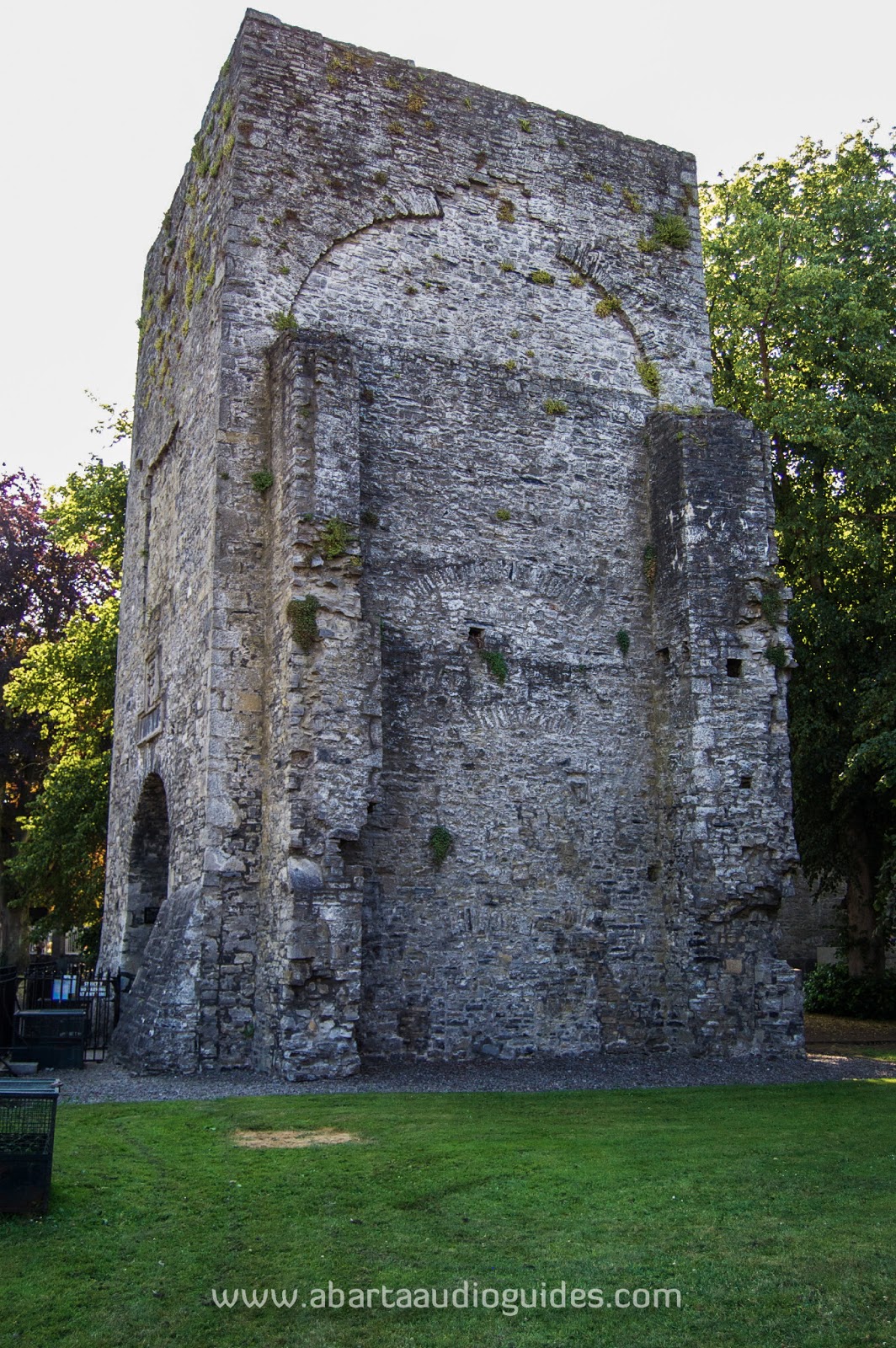
Maynooth Castle, County Kildare

 For over fifty years in the late fifteenth to the mid sixteenth century, Ireland was not ruled from Dublin, it was ruled from Kildare, by the powerful Fitzgerald dynasty based here in their castle in Maynooth.

After the Norman invasions of Ireland, the land around Maynooth in Kildare that had formerly belonged to the O’Byrne family, was granted by Richard de Clare the leader of the Norman forces to Gerald fitzMaurice fitzGerald in 1176. FitzGerald chose Maynooth to be the capital (known at the time as the caput). Originally it was thought that like many other Norman castles in Ireland, the first defensive structures on site would have been made of earth and timber. However in a recent article for Archaeology Ireland, Professor Tadhg O’Keefe of UCD convincingly argues* the case for the first construction to be of stone.
He notes in particular many similarities with the great donjon of Trim Castle, situated relatively close by in County Meath and suggests that there was sharing of knowledge, architects and builders between the two powerful medieval magnates of de Lacey and fitzGerald.

The keep or donjon of Maynooth Castle
By the end of the thirteenth century, the Fitzgerald’s became one of the leading Anglo-Norman families in Ireland. Their profile was boosted considerably in 1316 when King Edward II raised John fitzThomas fitzGerald to the Earldom of Kildare for his services during Edward the Bruce’s invasion of Ireland. However it was in the late fifteenth century when the fitzGerald’s reached their apogee. Gerald fitzGerald was trusted by King Henry VII to rule Ireland in his name. This brought huge wealth to fitzGerald and it was noted that Maynooth Castle was richly decorated. His son, [also called Gerald but known as Gearóid Óg] was Lord Deputy of Ireland for King Henry VIII three times (1513–34, 1524–28 and 1532–34).

He had unprecedented power in Ireland and jealously guarded his families interests. FitzGerald was summoned to London in 1534 by King Henry VIII, and he left his son Thomas as deputy governor in his absence. Thomas was a flamboyant young hothead, known as Silken Thomas for the silk his men wove into their helmets. A false rumour spread that the Earl had been executed by the King, Silken Thomas was enraged at the thoughts of his father being put to death in the Tower of London. He flew into a rage, and charged into St. Mary’s Abbey where the Kings Council in Ireland were meeting. He threw down the sword of state in an act of defiance, and immediately began a campaign against the Kings forces in Ireland. He had his men cut off the water supply to Dublin and laid siege to the City. The campaign was going well, until the Crown forces realised that Silken Thomas had neglected to defend his own stronghold of Maynooth. The English army under William Skeffington managed to negotiate their way into Maynooth Castle, but once inside they slaughtered many of the inhabitants. Silken Thomas heard of the bloodshed and immediately marched to try and save his family home, but he was ambushed and captured on the way. He was brought in chains to London, where he heard that his father had actually died of natural causes and had not been executed after all. Thomas and his five uncles were brought to the place of execution in London, Tyburn, and brutally executed by being hung drawn and quartered. The castle was thought to have been betrayed by Thomas’s foster brother Christopher Paris. The morning after Skeffington took the castle he offered his thanks to Christopher Paris and paid him for his services, but then ordered Paris to be beheaded, probably because he had shown himself to be a duplicitous character not to be trusted.

The undercroft or cellar level inside the keep has a number of interpretative panels
The execution of Silken Thomas and his uncles marked the effective end of the fitzGerald ascendancy, and by the early seventeenth century Maynooth Castle had started to fall into disrepair. Richard Boyle, father of the famous scientist Robert Boyle, became the guardian of the young George fitzGerald and became his father-in-law when George married Boyle’s daughter Joan. He spent large sums renovating Maynooth Castle and constructed a fashionable Manor House. As part of his works many of the original medieval domestic buildings were demolished. The castle suffered a number of sieges and attacks during the Catholic Confederacy Wars of the 1640s and was largely ruined. Squatters took over the castle and made their money extorting money from travellers by tolling the dirt track that runs through the castle which was once the main Dublin to Galway road. The fitzGeralds left their ancient family seat and eventually made Carton House their home.


The area of Boyle's Manor House with its fine arches
Today the castle is an OPW heritage site and you can you can still enjoy the lovely grounds and a trip around the imposing medieval keep. The lower levels have a number of panels that interpret the story of the castle and guided tours of the keep are available on request. The site is free to enter, for opening hours and further information please visit http://www.heritageireland.ie/en/maynoothcastle/


The surviving gatehouse to Maynooth Castle
I do hope you enjoy our blog, we are trying to cover as many sites across Ireland as we can. Please do consider supporting us as we need all the help we can get and we'd really appreciate it. You can support us by sharing our blogposts or by downloading one of our audioguides from www.abartaaudioguides.com, they are packed with original music by Enda Seery and sound effects to make a fun and immersive way of hearing the story of one of Ireland’s iconic heritage sites. They cost just €1.99 and you can enjoy them from the comfort of your own home or at the sites. If you want to try them out before you buy we have a number of guides available free to download, including the incredible Rock of Dunamase, Kells Heritage Town and an audioguide that describes all the archaeology discovered during work on the M6 motorway between Kinnegad and Galway, it’s the story of a landscape through its archaeology.

If you’d like to receive daily updates about great heritage sites then please consider following us on Facebook, Twitter and Google+.


*O'Keefe,.T. 2013, 'Trim’s first cousin: the twelfth-century donjon of Maynooth Castle' Archaeology Ireland, Vol 27 No.2. Pages 26–31. 


Navan Fort Visitor Centre, County Armagh

 One of the most important sites in prehistoric Ireland, Navan Fort (also known as Emain Macha) is an incredible place of mythology and archaeology. Like The Hill of Tara, one of the other great ‘Royal Sites’ of prehistoric Ireland, Navan Fort is part of a large and complex landscape of monuments in an area steeped in the legends of Ireland. It was said to be the capital of Ulaidh and home of the great Ulster Warriors of the Red Branch, Emain Macha was also the seat of King Conor MacNeasa and it is entwined with the story of the great Cuchulainn – Hound of Ulster, who discussed epic battles and heroic campaigns here. The importance of legends relating to Emain Macha lived on through time – the famous Brian Boru spent a night at Navan Fort in 1005 to prove his worth as High King of Ireland. In 1387, Niall O’Neill chose Navan Fort as the location for a house where he could entertain guests – hoping to impress them with his wonderfully historical location.
However, in the 1960s this important site came under threat as a local quarry that was located very close to the northern part of the site, wanted to expand. The quarry was already located adjacent to Loughnashade (or Lake of the Treasures) so any expansion would have meant certain destruction of archaeological deposits. An archaeological team headed by Dudley Waterman began the enormous task of excavating the site, to try to understand more about life in one of Ireland’s most important Iron Age royal centres, and to try to assess how the physical remains could match the historical and mythological descriptions.

They discovered a large enclosure that encompasses an area of around 6 hectares, at the heart of the enclosure there are two visible monuments; a large circular mound and an earthwork known as a ring-ditch. The information that came from the excavation of these features gave a startlingly complex story of activity that stretches over millennia. However the main activity on site seemed to centre around the Iron Age, around 2100 years ago in 90BC.

A huge wooden temple was constructed at the summit of the site, using over 280 large wooden posts.
Reconstruction model of the enormous wooden temple
Strangely there is no evidence to say that anyone lived in this massive structure. Instead shortly after its construction, the temple was filled to the roof with a cairn of limestone rubble, then the wooden structure now completely filled, was then burned down and the remains of the cairn were carefully covered with a mound of soil. This unusual and unparalleled activity is one of the great mysteries of prehistoric Western Europe. Why did they go to this incredibly time consuming labour intensive trouble of building a structure of enormous dimensions, only to then fill it with stones and destroy it by burning? What Gods were they hoping to placate? For what reason? Theories in archaeology abound about this strange behaviour, though no-one can say with any certainty the reason behind it. It is often the case in archaeology that by excavating a site you end up with more questions than you had before you began, the mound at Navan Fort is certainly a great example of that!
Poignantly, the excavators also discovered the skull of a Barbary Ape in Iron Age deposits at Navan Fort. This ape came from Northern Africa or Gibraltar, and no doubt was a little bewildered to find itself in (comparatively) cold and wet Armagh. This ape would have been an object of huge curiosity and was likely to be a treasured possession of the ruler at Navan Fort, who would have shown off his ability to trade with far flung and exotic places. More artefacts of immense importance were discovered in the ceremonial pool, Loughnashade. Four beautifully made bronze horns / trumpets were discovered in 1798, along with a quantity of human bones. These trumpets were the largest prehistoric horns ever found in Ireland and are thought to date to around 2,000 years old. Of the four trumpets unfortunately only one survives today, the other three have disappeared. From the surviving trumpet replicas have been created, to hear what these ceremonial trumpets would have sounded like check out this YouTube video and just try and imagine yourself as a homesick Barbary Ape https://www.youtube.com/watch?v=EDgv5O8i8RU

We will never truly understand all the secrets of Navan Fort but it is certainly well worth a visit as it is a site that has retained its importance through the centuries. Simply by standing on the summit of the remains of that large temple looking out over the landscape, one can understand how this became known as the great home of the Knights of the Red branch and how it was immortalized in tales of heroes. We strongly recommend paying a visit to the excellent visitor centre, where you can enjoy an exhibition and audio-visual that describes what was found during the excavations.

There are also wonderful living history displays where you can experience life during the Iron Age and guided tours to the site are also available. To find out admission prices and more information please visit http://www.armagh.co.uk/place/navan-centre-fort/

I do hope you enjoy our blog, we are trying to cover as many sites across Ireland as we can. Please do consider supporting us as we need all the help we can get and we'd really appreciate it. You can support us by sharing our blogposts or by downloading one of our audioguides from www.abartaaudioguides.com, they are packed with original music by Enda Seery and sound effects to make a fun and immersive way of hearing the story of one of Ireland’s iconic heritage sites. They cost just €1.99 and you can enjoy them from the comfort of your own home or at the sites. If you want to try them out before you buy we have a number of guides available free to download, including the incredible Rock of Dunamase, Kells Heritage Town and an audioguide that describes all the archaeology discovered during work on the M6 motorway between Kinnegad and Galway, it’s the story of a landscape through its archaeology.

If you’d like to receive daily updates about great heritage sites then please consider following us on Facebook, Twitter and Google+.

Mellifont Abbey, County Louth

 Mellifont Abbey was the first Cistercian Abbey in Ireland, known to the Cistercians in Ireland as the ‘Mother House’, a base from where the Cistercians expanded, adding more and more institutions (known as ‘daughter houses’) across Ireland. The name Mellifont comes from the Latin, ‘Fons Mellis’ meaning ‘Fount of Honey’.

The Cistercian Order was founded by St. Bernard of Clairvaux in Burgundy, Central France in 1098. St. Bernard believed that the other monastic orders had become dissolute and undisciplined, and he founded the Cistercians as an austere and hard-working order who focused on a life of prayer. St. Malachy of Armagh, the Irish Saint and friend of St. Bernard, founded Mellifont Abbey in 1142 with a group of Irish and French monks.


The Abbey was extremely successful from it’s earliest stages, and it developed rapidly. Monks from Mellifont were dispatched to found ‘daughter houses’ around Ireland, within just five years of the foundation of Mellifont in 1147 a daughter house had already been established at Bective in County Meath and within twenty years the Cistercians had establishments in Connacht, such as that founded at Boyle, County Roscommon in 1161. It is recorded that at least 21 abbeys were founded by monks from Mellifont.
The Cistercian community in Ireland faced a grave crisis following the Norman Invasions of Ireland in the late twelfth century. Irish established Cistercian institutions such as Mellifont became embroiled in a power-struggle with the Cistercian establishments that came from England following the invasion. The outcome of what became known as ‘The Conspiracy of Mellifont’ led to a dramatic reduction in the powers and number of monks allowed to Mellifont. Despite these restrictions, Mellifont remained one of the richest monastic institutions in Ireland due to it’s huge landholdings of the rich agricultural land of Meath and Louth.

It was probably due to this vast ownership of prime land that Mellifont was one of the first of the Irish monastic sites to be Dissolved in 1539 during the Dissolution of the Monasteries. Mellifont became the private fortified home of Sir Edward Moore, and it was here that the famous Treaty of Mellifont was signed in 1603 that ended the bloody Nine Years War. Later Mellifont played host to William of Orange, who established his headquarters at Mellifont during the Battle of the Boyne in 1690.


Of the site itself there isn’t much of the original Abbey left standing today. However excavations have revealed the foundations of many of the buildings, so it is easy to get a good sense of the size and layout of this important Abbey. Mellifont became the standard format for all Cistercian Abbeys in Ireland, and many other monastic orders were influenced by the layout. The cloisters were positioned at the south, and were surrounded by a range of domestic and spiritual buildings, with a cruciform shaped church to the North. The site is certainly worth visiting for its famous Lavabo. This building is in the Romanesque style of architecture, and dates to the early thirteenth century. It is octagonal in shape and served as the ritual washroom, where the monks would wash their hands before entering the refectory for meals. Excavations revealed fragments of lead pipe that brought the water into the central fountain. The interior was decorated with delicate images of plants and birds. A number of fragments of the fine architectural features are on display in the visitor centre.
You’ll find Mellifont about 10km north-west of Drogheda, off the R168 (Drogheda-Collon Road). Guided tours are available from the Office of Public Works from the 30th May to the 28th August. Open daily from 10.00am – 6pm (please note that last entry is at 5pm). Prices are €3 for an adult, €2 for over-60’s, €1 for children/students. For more details please see their website here.

I hope you enjoy this blog, we're trying to cover as many sites as we can across Ireland. If anyone has any suggestions about sites you'd like us to cover please do leave us a comment. If you enjoy information and images of Irish heritage sites then do follow us on Facebook, Twitter and Google+ If you'd like to support us then please consider downloading an audioguide to one of Ireland's wonderful heritage sites. They are packed with original music and sound effects and are a great way of experiencing the story of Ireland. They only cost €1.99 and are fun whether you are at the site, or listening from the comfort of your own home. If you enjoy stories of the turbulent medieval period in Ireland try our guide to Viking and Medieval Dublin, visit us at www.abartaaudioguides.com for free previews and to download your free audioguide to the Rock of Dunamase or the free audioguide to the wonderful heritage town of Kells in County Meath

All photographs © Neil Jackman / abartaaudioguides.com