Showing posts with label Hard Gear. Show all posts

POV: Fuji X-T1 Goes To Vietnam

Fuji X-T1/Zeiss 12mm f2.8-Photo © Tewfic El-Sawy-All Rights Reserved

"It is the photographer, not the camera, 

that is the instrument."- Eve Arnold


Well, this is the first time I travel on a photographic expedition without a DSLR (or two or three) since I started them in 2000 (or even earlier).

Yes, I traveled for almost 3 weeks to Viet Nam with two Fuji cameras and a Leica M9...and a bunch of lenses. I wrote about that in fuller details in a post titled The "Unbearable" Lightness of Fuji X Series. On my return, I tallied an estimate of my usage statistics, which are as follows:

Fuji X-T1 + Zeiss Touit 12mm f2.8: 75%
Fuji X-Pro1 + Fujinon 18mm f2.8 : 10%
Leica M9 + Voigtlander 40mm f1.4: 15%

And asked myself if I missed my Canon 5D Mark II and my panoply of primes and zooms?

Not once was the answer.

I've been a loyal Canon user since I've started photography, and I have nothing but praise for its cameras. I shall still retain my Canon 5DII and a bunch of lenses for as long as I can. However, I realized that my style of photography has evolved during the past few years...prompting me to splurge big time on a Leica M9, and not too long ago on a Fuji X-Pro1.

The evolution of my way of seeing, the lightness of these two cameras and the quality of their images laid the foundation for my being ready and very receptive for a DSLR replacement. Traveling to photograph Holi in India earlier this year, and having to hold the 5DII at shoulder-length to photograph inside temples and avoid color powder/water bequeathed me a short-lived tennis-elbow like pain, but it made me realize that DSLRs are really heavy computers with lenses attached to them.

And I only used a fraction of its menu settings. 

The arrival of the Fuji X-T1 on my radar screen was timely. As I said, I was ready, willing and able to replace the DSLR with a smaller tool...and there's no question in my mind, especially after my using it in Viet Nam, that it is a DSLR-killer for me. 

I am not a fan boy of anything. Cameras are nothing but sophisticated tools. I used Canon cameras, I use a Leica M9, a X-Pro1 and now a X-T1. They're all good cameras...there are no bad cameras in this day and age. They're all technologically very advanced, and it's largely a matter of choice, familiarity, and ergonomics what works for you and what doesn't.

Fuji X-T1/Zeiss 12mm f2.8-Photo © Tewfic El-Sawy-All Rights Reserved
I won't get technical in this POV. There are tons of bloggers more qualified than I am who have dissected the pros and cons of the Fuji X-T1, and from what I read, the large majority agree that the X-T1 is a game changer.

During my Viet Nam photography expedition, I've worked with the X-T1 on a daily basis. Shooting normally or shooting from the hip in the streets, it performed extremely well. The quality of its built is excellent, and it feels just right...its weight, its controls and its ergonomics are right.

I always say that the Leica M9's overall feel is just right. It's a thoughtful camera. So is the X T-1. Totally different cameras of course...but both are well built and well thought out.

It feels like cheating to be able to frame a scene, twiddle the exposure compensation knob (placed on top of the camera), and see what happens to it in the utterly brilliant LCD. Everything I need is on top of the camera. Yes, there are small annoying quirks...some are due to operator error, and some are of  the "it is what it is, so work with it" kind.

I sort of rolled my eyes when I learned that the X-T1 had a tilt-screen. Trust me, I don't do that anymore. It's quite useful for low shots and for shooting in the streets. The shutter is quiet. I was shooting with people who had Nikons...and they sounded like Big Berthas.

The CH is about 8 frames per second, and while there seems to (occasionally?) be a sort of grey-out between shots at that speed, it didn't bother me. I doubt if it's really 8 frames per second, but it's fast enough for me.

Fuji X-T1/Zeiss 12mm f2.8-Photo © Tewfic El-Sawy-All Rights Reserved

The auto focus needs to get used to. The AF-S is pretty good. Maybe not as good as the Canon 5DII, but I learned to live with an occasional lapse. I have not used the AF-C yet, but my understanding is that it needs to be fiddled with in the camera's settings. 

What else? Ah yes. The battery life sucks. The LCD just sucks the juice out of these small batteries. So I was quiet happy to invest in a battery grip, and work in the field with two batteries in the camera. I had to rely on the "back-up" battery when I was out all day shooting...and I had an extra battery stashed away just in case. I also saved juice by turning off the display, and keeping my chimping to the absolute minium.

The X-T1 is weather-sealed. I photographed in the rain (steady rain-drizzle...not a monsoon downpour) and it was fine. I just wiped off the drops with my scarf and that was it.

The humidity was intense all through the trip, and I lost tons of water...but despite it all, the X-T1 didn't feel slippery. Really good grip...and good solid knobs (except for the four-way pad on the back).

I found that I had to really make sure that battery compartment in the grip was locked properly. It sometimes didn't...but it might also have been my error.

I'm not going to get sucked in a debate about the merits of full frame versus cropped sensors. Would I prefer that the X-T1 be full frame? Perhaps, provided the lenses still remained light and compact....and I don't think that's going to happen any time soon. And from what I've seen, the IQ of the X-T1 is really formidable, and its high ISO capabilities are impressive. So that debate is not for me.

I used the Zeiss Touit 12mm f2.8 lens on the X-T1 most of the time. Occasionally, I used the Fuji 18mm for street work, and the 18-135mm was only used during the fishermen photo shoot, and one time around Hoan Kiem Lake.

I very much like both the prime lenses I own. They're sturdy...workhorse kind of lenses, and they reflect my shooting and framing preferences. The 18-135mm zoom lens -while quite good and responsive- is nowhere close to the prime lenses as far as I'm concerned. Perhaps I've moved away from zooms. It's a very useful lens to have, and some may consider it the only lens they need for travel. I don't disagree that it is all that...but personally, I'm into prime lenses.

So far, much of my post-processed work from the Viet Nam photo expedition was in monochrome. I shot in B&W with the M9, and color with the X-T1 (and then both processed/converted to B&W using Silver Efex).

These photographs are featured on Hanoi Noir. Try guessing which are Leica and X-T1.

And the audio slideshow below is of the same photographs.

POV: The 'Unbearable' Lightness of Fuji X Series


Well, time does fly and I'm preparing to leave for Hanoi to start my The People of Tây Bắc Photo Expedition-Workshop in a few days.

This trip is something of an important chapter in my timeline as a travel photographer, as it'll be the first time that I leave my heavyweight DSLRs home. I've traveled before with just a Leica M9 and the Fuji X Pro-1 (as to Guatemala last month), but this is the first photo expedition-workshop that sees me DSLR-less.

I've tested the Fuji X-T1, the new addition to this group of non DSLR tools, in the streets of New York City and over the past two weeks, found it reliable and responsive, and I believe it'll perform well in replacing my aging Canon 5 Mark II. The Fuji X-T1 has its drawbacks and quirks, but from my past experience with the X Pro-1, these are mostly caused by my being unfamiliar with its minor idiosyncrasies.

What will accompany me to Vietnam is this: (from the top left) Marantz PMD 620 audio recorder,  a Voigtlander Nokton 40mm f1.4 (Leica mount), Leica M9, Fuji X Pro-1, a Fujinon 18mm 2.0, a Fuji external flash EF-X8 (for fill-in if needed), a XF18-135mm f3.5-5.6 and the Fuji X-T1 with a Zeiss Touit 12mm f2.8.

I roughly calculated that the combined weight of all these is a little over 6 lbs. or 3.0 kilograms at most. Feather weight in comparison to what I used to schlep before. All of which will fit very comfortably in my small Domke F-8 shoulder bag, along with two 2TB hard drives...and other paraphernalia.

So it'll be an rangefinder (M9) for portraiture, a hybrid (or pseudo) rangefinder (X Pro-1) for street photography, and the mini DSLR (X-T1) for travel-documentary photography. 

For the X-Series cameras, I'm bringing along 5 batteries (3 back-ups/spares) which will be charged every night.

On my return, I'll be in a better position to relay my impressions and experiences with the Fuji X-1 and the various lenses.

PS. Yes, I cover the brand names of my cameras with black gaffer tape.

Fuji's Full Frame VS "Full Size" APS-C


"It is the photographer, not the camera, that is the instrument." -Eve Arnold

The internet lit up (well, almost) the other day when eagle-eyed Fuji aficionados and others read the Fuji Press Release for Photokina 2014 to read this:

"We will be unveiling our latest lineup of X-series digital cameras along with interchangeable lenses and peripheral accessories at this year's Photokina. At the Touch and Try Corner of the Fujifilm booth, visitors will be able to experience the outstandingly high image quality with a full size sensor and high resolution images taken with the new lineup of cameras that feature FUJINON XF interchangeable lenses."

Reading the words "a full size sensor" led many to believe that Fuji would be announcing a new full frame sensor in a couple of weeks. Not reading it carefully left me, having just acquired the new X-T1 and the 18-135mm lens, with the taste of sawdust in my mouth, and using the English equivalent of "merde!", I started calculating the costs (if any) of returning the X-T1 and the lens to the retailer I bought it from...cursing the day I decided to buy it in the first place...less than week or so.

On my Facebook page, I expressed my view that I didn't think the difference between a full frame and a cropped one was of such critical importance with technological advances in the APS-C sensors. There's certainly differences, but as many other photographers attested to, these differences have to balanced against the many positives of using an excellent mirrorless system such as Fuji X-Series.

Photo © Tewfic El-Sawy-All Rights Reserved (XT-1/Fujinon 18mm)


I also expressed my surprise that Fuji would go full frame (or full size) as it had no lens line-up that would work with a full frame camera. It actually referred to its existing XF interchangeable lens system. 

So somewhat relieved...I concluded -after reading the paragraph in question- that it had to be a copy writer error, and that I didn't have to return my X-T1 after all. This was confirmed a day or two later when Fuji re-issued its Press Release and corrected it to say "the emphasis will be on the high resolution of the APS-C sensor, which rivals that of a full frame sensor.”

My initial knee-jerk reaction was a silly one. The X-T1 is an exceptionally good tool, and while I've discovered over the past few days that it has some quirks (and I will probably find more), it's certainly a worthy replacement for my aging (and super heavy) Canon 5DII and the 7D...along with their back-breaking glass.

I'm not a tech-head and I'm not saying (or even thinking) that APS-C is as good as a full frame. Bigger is better in this case...but the difference is smaller than what many photographer think...but sometimes, we are wedded to notions that are past their prime, and with the technological advancements in sensor manufacturing, this is no longer the case.

My view is simply this: I am delighted to be able to rely on a smaller and lighter system than what I used for the past 14 years. I'm not yet ready to get rid of my DSLRs just yet, but I'll have to decide really soon. In the meantime, Vietnam beckons and leaving my DSLRs behind will be the real test.

Fuji X-T1/Zeiss Touit 12mm/Grip

Speaking of Vietnam, the X-Pro1 served me extremely well during my Photo Expedition-Workshop of 2012. I used it for street/candid photography and although it's auto-focus capabilities weren't ideal, it allowed me to photograph discreetly in situations where my Canon 5D Mark II would've been too intimidating, and the quality of its images were up to my expectations. The new Fuji X-T1 will hopefully surpass my expectations that it will generally outperform (or perform as well as) my DSLRs.

Going Minimalist | Guatemala Foundry Photojournalism Workshop

In just over a week, I'll be traveling to La Antigua in Guatemala to join the rest of the faculty of the Foundry Photojournalism Workshop.

Since I'll be spending most of the week-long workshop teaching the fundamentals of multimedia, I won't have much time to work on any personal projects, so will probably only do some street photography.

It'll be an opportunity (and a joy) to leave behind the heavy DSLRs, and travel with a minimalist gear which, as shown in the above photograph, may consist of a Fuji X Pro-1 with a Fujinon 18mm and a Zeiss Touit 12mm, a Leica M9 with an Elmarit 28mm and a Voigtlander Nokton 40mm f1.4 as well. And just in case I need to record some audio, I'll pack a Marantz PMD 620, much smaller than my Tascam DR-40 that I use on my photo expeditions.

In the last Foundry Photojournalism I attended (Chiang Mai), I relied on these two "rangefinders", and it was a relief to be carrying one or even two of these comparative light tools instead of my two Canon DSLRs.

It's not my first time to Guatemala or La Antigua. I was there some years ago during its famous Semana Santa. Some of my photographs are on Las Tierras de Popol Vuh.

For those who don't know, The Foundry's goal is to help emerging photojournalists and documentary photographers to hone their skills, to have a chance to work with some of the world’s best shooters in the field, on real reportage projects, to create multimedia, to see some of the best work being done today, to collaborate, to make contact, plan future projects, develop your own vision and leave the workshop energized, and more committed then ever to concerned photography, storytelling and to documenting the world through the lens.

Getting Ready | Gear Porn


The time draws nigh for my departure to Delhi, where I'll stay for a couple of days before leading The Sacred Cities Photo Expedition-Workshop to Varanasi and Vrindavan.

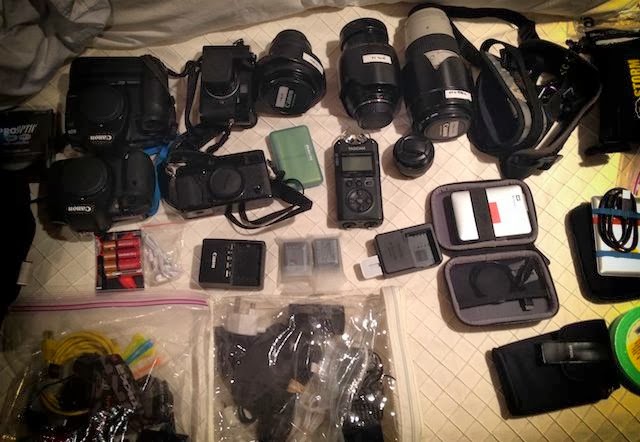
This weekend will  see my sorting out the gear I plan to take along with me on this two weeks photographic trip, and having to plan to protect my cameras during the week-long Holi festival is an added preoccupation.

I usually place all items of my gear on a sofa, so I can visually inspect each....then clean and check the operation of each item. I also either recharge or refresh batteries.

So far, the gear list consists of:

1. Canon 5D MarkII and a Canon 7D (as back up and for video).
2. Canon lenses: 24-70mm 2.8, 70-200 2.8, 17-40 4.0.
3. Fuji X Pro-1
4. Fujinon 18mm 2.0
5. Leica M9 and the Elmarit 28mm 2.8. ***
6. Tascam DR40 Sound Recorder
7. 3 Portable Hard Drives (iomega and WD)
8. Two Black Rapid Straps
9. Gaffer Tape And Ziplock Bags
10. Rain Covers (for Holi) and spare UV Filters.
11. Spare Batteries, Memory Cards.
12. Various electronic paraphernalia, thumb-drives, chargers, etc.
13. A 13" Macbook Air, and a iPad Mini Retina.
14. An iPhone and a Blackberry (for local SIM card).

**The Leica gear may or may not make the final list. It will depend on the final configuration of my camera bags.

All this gear will have to fit in my beaten-up Domke F8 bag and in my brand new Wotancraft Atelier's Scout camera bag. I'll carry both on my flights, but the Canon 70-200 lens may have to travel in my checked luggage. Although my usage of this long lens has decreased considerably over the past few years,  I expect I'll have to rely on it a lot more on this upcoming trip.

POV: And Off I Go....


This ought to be the last blog post written in New York City as I'm flying to London, and on to Delhi to begin my two weeks Sufi Saints of Rajasthan & Kashmir Photo Expedition-Workshop. During this photo expedition, I shall keep my readers in the loop as much as I can.

I'll spend a few days in London where I have to look after some business, and I'm delighted to learn that The Natural History Museum is featuring the world premiere of Sebastião Salgado: Genesis, and which I'm planning to visit no matter whether it rains or the sun shines. He's one of my favorite photographers, not only for the beauty of his work but also because of his photographic philosophy.


Then it's a direct flight to Delhi where I arrive at 11:00 am on Friday May 3rd, and plan to meet with friends. I have much to do for the first few days prior to the arrival of the group of photographers who joined this workshop, and hope all will pan out as planned.


As is frequently the norm with my photo trips, the group members come from various corners of the world; the USA, the UK, Ireland, Bahrain, Denmark and Canada. 


Nine photographers all told...who, with their photographic and audio gear will work in Srinagar for 4-5 days in this unique Kashmiri city known as the land of Sufis Saints,  then to Ajmer in Rajasthan; the holiest of cities for Sufis, and where the shrine of the Sufi saint Khwaja Moinuddin Chisti, equally revered by Hindus and Muslims, will witness the commemoration of the death anniversary of the saint in unparalleled manifestations of Sufi fervor and devotion.

Photo © Tewfic El-Sawy-All Rights Reserved


I can't wait to photograph incredible people such as the Sufi punkhawallah above, and start producing audio-visual stories at these locations. My gear has been cleaned, lenses polished, CF and SD cards checked, and hard drives spun and re-spun.

India, here I come.


RØDE i16: 360º Surround Recording


I'm fascinated at how the iPhone is (and continues to be) an essential component in most photographers' arsenal of tools with new accessories and apps.

I was recently tempted by RØDE’s iXY microphone for the iPhone, but now the company has produced  the RØDE i16 which consists of sixteen individual gold-sputtered cardioid condenser capsules, allowing the user a high amount of freedom to record in either surround, stereo, mono, or anywhere in between.


The company claims that the software inside the RØDE i16 will allow the cancellation of background noise through phase manipulation of the other channels, working much in the same way as noise-canceling headphones, and may be more effective at recording dialogue than a traditional shotgun microphone.


The i16 is available with both Apple Lightning (iPhone 5, iPad mini) and 30-pin connections. Both are shipping now, with a MSRP of US$399.

For more technical details, take a look at RØDE i16  home page.


Have a good look at the picture above. This looks like the most unwieldy device I've ever seen. So it sounds like an April 1 Fools joke. We'll see.

POV: Creation Of A Tintype Photograph


Readers of this blog know of my current flirtation with the wet plate look, so I'm glad to have found this short movie describing the rather finicky process of creating a tintype photograph. Bob Shimmin is the photographer describing this process, and he makes it look simple...and it isn't. It's slow and deliberate, part science, part alchemy and art. He has been working in the little used photographic process of wet plate collodion for a number of years.

This video is part of the Kalamazoo Valley Museum special exhibit - Remember Me: Civil War Portraits. You can also watch how Shimmin got involved in tintype photography on this documentary.

I learned from scouring the web that tintypes were introduced in 1856 as an alternative to the daguerreotype and the albumen print, the tintype was widely marketed from the 1860s through the first decades of the twentieth century as the cheapest and most popular photographic medium. It differs from the wet plate because the light sensitive material is coated onto a piece of iron rather than glass...but the process is similar.

I've also found Penumbra Foundation Center, which is a New York City organization dedicated to preserving historical and emulsion based photography, and which offers tintype (and other alternative processes) workshops.

Of course, if that is too cumbersome or complex, there's always the Hipstamatic Tinto 1884 App or the Alt Photo App for the iPhone! My gallery of portraits made using desktop version of the latter app is The Digital Wet Plates.

RODE iXY Microphone For The iPhone


It certainly appears the iPhone is becoming the all-in platform for multimedia photographers with the newly announced RODE iXY microphone by the Australian company. The press release claims that this stereo microphone for the iPhone (and iPad) with  the 30- pin connector allows high quality recording at sampling rates up to 24-bit/96kHz,  and that it's the only microphone on the market to do so.

The iXY is supplied with a foam windshield for outdoor recording as well as a reinforced protective zip case, and is sold for $199 on the RODE Store. The initial launch stock has sold out at the time of writing this post, but the company is expecting further shipments soon.


There are two apps available from Apple's iTunes for the RODE iXY microphone. The free version and the $5.99 pro version. The latter allows audio recording features such as gain, input, boost levels, high/low-pass filter options, equalization effects and much more.

I'm not sure how this device will fare against the stiff competition from the TASCAM PCM iPhone app and much cheaper Tascam iM2 microphone ($30), or against the portable audio recorder TASCAM DR-40 ($135) or the ultra cheap Zoom H1 ($90). Perhaps the fact that users won't have to carry two devices (iPhone and audio recorder) and its high sampling rates will be determining factors.


That said, I view the iXY more as a microphone for DSLR videographers than as a handheld audio recorder.

Note: I have no relationship with TASCAM (nor with RODE for that matter) other than being a consumer.


POV: Is It Time For The Mamiya 645 (Again?)


I've been thinking about my Mamiya 645 film camera and its 80mm f2.8 Sekkor for some time. It's been stored in my closet for some 20 years...virtually untouched. I had bought it at the start of my photography hobby (which it was then), and used it to learn the craft, thinking that I would continue using it...but with the technological advances in the SLRs and later on, the DSLRs...it was forgotten and sat forlornly in the closet ever since.

I believe cameras are tools; nothing more and nothing less. And I just couldn't think of a specific use for this tool. Although some photographers use it very successfully while traveling, travel photography generally doesn't lend itself to medium format cameras, whether digital or film. They're bulky, heavy and impractical in non-studio settings (or so I think).

However, the quality of its images is superlative.

It needs a bit of a professional cleaning, but before I do that, I'll try it out for a while on local mini personal projects. So I looked around and found that B&H stocks Kodak Tri-X 120 and other brands, and The Darkroom, an outfit in California processes film, and can also digitally scan the film on a CD.

We'll see if this impulse survives the coming few weeks, especially as I've embarked on a minimalistic panoply of tools, or is it just a flash in the pan.

PerPower EZBoost

With lower Manhattan losing power, most of its residents had to walk north for at least 20 blocks from to recharge cell phones and laptops at mid-town bank branches, hotel lobbies and cafes, I thought I'd feature the availability of the PerfPower EZBoost.

The PerfPower EZBoost claims that it's "the most powerful portable mobile charger" small enough to fit in one's pocket, but powerful enough to charge a mobile device nearly 4 times from fully drained to completely charged. It's powered by standard alkaline batteries or rechargeable batteries, and can be used anywhere and anytime.

It's very inexpensive, and available from Adorama. I have no idea if it lives up to its claims, but it might be a useful option to have around.

By the way, both B&H (420 9th Ave. at 34th St. ) and Adorama (42 W 18 St) have set up charging stations for cell phones et al in front of their respective stores. These are free of charge.


TASCAM PCM iPhone App


I've just discovered this lovely app by browsing the web, and it's the TASCAM PCM Recorder, which is free and turns your iPhone, iPod Touch or iPad into a portable stereo recorder.

It has input and output level faders with an “on-screen” meter to check levels, and includes high and low EQ and a limiter to prevent overload. Pretty neat, isn't it? I tested it very briefly at home, and intend to test when Hurricane Sandy is out of the way...perhaps with the musicians in Washington Square Park.

It records in WAV format, and these audio files can be uploaded to Soundcloud as well. It seems it's only for iPhone (iPad and iTouch as well) for the time being. TASCAM also produces the iM2W, a small microphone designed specially for the PCM, which effectively turns the iPhone into a field recorder. It retails for $59, and might provide better audio quality than the built-in iPhone mic.

This is certainly worthwhile to consider, especially for those who are interested in joining my photo expeditions-workshops and/or my class at the annual Foundry Photojournalism Workshop...especially the latter who often are on budgets.

I shall recommend this alternative to buying an entry-level recorder, provided those interested already have iPhones. I expect the quality won't be much different between the two devices.

Disclaimer: I have no relationship with TASCAM other than being a consumer.


POV: New Stuff

Oaxaca-Photo © Tewfic El-Sawy-All Rights Reserved
(Click To Enlarge)
Hanoi-Photo © Tewfic El-Sawy-All Rights Reserved
(Click To Enlarge)
I've mentioned the evolution of style over time in yesterday's post, and I thought I'd add my experience in that one's style evolves with one's exposure to, and the availability of, new imaging software...as well as to improved photographic gear.

I was always a sort of purist (if that's the right word) when post processing my digital images; resisting almost any modification in them except for some sharpening and exposure changes...and seldom, if ever, cropping my photographs (except when street photographing and shooting from the hip).

Having a phobia of spending more than a few minutes on Photoshop, I welcomed Lightroom's preset filters (that I still use) which allowed me with a click of a button to obtain the "look" I wanted for my images. I relied on simple and plain vanilla presets, eschewing the funkier ones that were, in my opinion, too extreme.

With the advent of Instagram and Hipstamtic filters on my iPhone, my limited tolerance for these funky filters turned into an embrace of sorts, which eventually widened my willingness to experiment with other software.

So it was with undisguised eagerness that I started using Alien Skin's Exposure 4 on my return from Vietnam. I had heard of it, but given my allergy of "manipulation", I never thought of trying it out before.

I used it to give a pseudo-Daguerreotype look to some of my photographs from Sapa and Bac Ha, and I was hooked ever since.  I now happily toy with its various options, especially the classic films, like Kodachrome, Polaroid, and Panatomic-X.  A click...a few nudges here and there, and I have the look I want.

The two photographs above; the top made in Oaxaca of a street festival in 2010, and the lower one made in Hanoi last month, were processed in Exposure 4, using the Polaroid 669 film simulation preset...one of my current favorites...enhanced with vignetting. Another milestone in my evolution.

Something else to report is that I recently got two Bip soft shutter buttons manufactured by matchTechnical Services. They're the outfit that manufactures the Thumbs Up for the Leica, which I have on my M9, and -as I previously posted a few times- like very much.


You can see them on my two cameras; one on my M9 (right) and the other on my X Pro-1. It's very smooth on the M9, but as I mostly shoot from the hip with the X Pro-1, I am finding that I have to get used to the different "travel" time of the shutter with the Bip on it.


In retrospect, I ought to have chosen red Bip for the M9.

Disclaimer: I have no relationship with matchTechnical Services or with Alien Skin other than being a consumer.

In Brief: The Fuji X Pro-1 In Vietnam

© Yep, Mine Alright.

There's no question in my mind that I am very fond of my Fuji X Pro-1 and satisfied with its performance, as I've used it quite a lot during my just completed Vietnam Photo Expedition-Workshop, especially in situations which warranted candid photography (aka shooting from the hip, for me) such as during the crowded Sunday market in Bac Ha.

Many photographs on my recently completed audio slideshow Hill Tribes In The Mist and The Indigo People were made with the X Pro-1...and I'm quite happy at the results.

However, not all is rosy. While viewing some of my image files at the market, I noticed that perhaps 50 or so of my images (out of probably 1000) were really blurry. Since these images were consecutive on the "roll", it meant I made an error and it happened accidentally.

I can't recall now how I rectified this, but I think it was by reverting the focus mode lever to Single AF which had somehow slipped to Continuous. Being on the latter setting meant that the camera's focus was continually adjusted according to the scene, and with the constant movement of people in front of the lens, it may have been this that resulted in blurry images...remember, I shoot from the hip (or from the waist).

Not good that. And irritating.

The other issues I have with the X Pro-1 are these: the Exposure Compensation Dial and the lens aperture ring can easily and inadvertently be knocked off my preferred settings without me noticing it until I look at the LCD monitor and view my images. By that time, I've missed my shots.

My Preferred Settings (Aperture & Exp Comp Dial)
I suppose a piece of black tape would keep the focus mode lever and the Exposure Compensation dial where I like it. But I would've hoped that the Fuji engineers had made these less prone to inadvertent movement.

Another peeve: I carried three batteries, and inserting them the right way took some head scratching. Should they go in this way or that? An easy fix would be to use some nail polish to mark the batteries in a way that eliminates the guesswork.

This I can do.

New Fujifilm X-E1


Fujifilm has just announced the new X-E1 mirrorless camera, which is a smaller sibling to the successful X Pro-1. It features the same 16.3 mp CMOS sensor as the X-Pro1, but has a smaller and lighter body.

It features a 2.8-inch LCD, a pop-up flash, ISO of 200-6400 (expandable to 100-25600), and RAW and built-in RAW conversion, but doesn't have the hybrid viewfinder found on the X Pro-1. It only has a EVF. It's much lighter than its larger sibling, and in terms of size, it's 30% smaller.

I haven't used my X Pro-1's video mode (relying on the Canon 5D Mark 2 when I needed to) but the X-E1 can shoot 1920×1080 video at 24fps, and Fuji's Film Simulation option can be enabled during video recording...nice!

I leave it to you to decide if the X-E1 will be as successful as the X Pro-1. My initial reaction is that it might be too small...even for a second body. However, it's supposed to have a retail price of $1000...$700 cheaper than the X Pro-1.

POV: Finally! A Minimalist Gear....


I'll be in Chiang Mai in a few days for the Foundry Photojournalism Workshop which formally starts in a week from today. I wasn't keen to haul my usual gear with me, especially with my stops in London and Bangkok, so I have just what you see in the picture.

Depending on whether I have the time or not, I intend to shoot a couple of personal projects in Chiang Mai so I chose to take a Leica M9 with an Elmarit f2.4 28mm and a Voigtlander f1.4 40mm, a Fujifilm X Pro-1 with a Fujinon 18mm and the Tascam DR-40 to record audio. All of this fit in my small Domke F-3X (with room to spare); a small and tough shoulder bag I've been using almost incessantly for a couple of years. I shouldn't forget to mention my iPhone4S, which will be useful for ah hoc photography.

Heck...the Tascam audio recorder is larger than either of these two cameras!!!

I will post sporadically during the coming two weeks...with most of the posts from Chiang Mai and the Foundry Workshop.

Black Rapid: Lens Bling


I use BlackRapid Camera straps, and just noticed that the company announced the launch of LensBling, a series of rear lens caps that allow users to quickly and easily differentiate between lenses they own. The rear lens caps carry bold graphics and labeling so it's very easy to identify and quickly find the right lens in a camera bag.

Alternatively, one can do what I do...and that is to print labels with the focal length of the lens, and stick these to the lens' front and rear caps (and sometimes the hood as well).

Notwithstanding, the LensBling is much more elegant and only cost $8.50 each. Not bad.


Note: I am not sponsored by BlackRapid, nor associated with it in any fashion. As I said, I just like and use its straps, and I thought that this product may be of interest to my readers in the travel and documentary photography industry.