Showing posts with label Nepal. Show all posts

Michael Švec | The Kingdom of Mustang

Photo © Michael Švec-All Rights Reserved
Mustang (derived from the Tibetan word Möntang) is the former Kingdom of Lo where Tibetic languages are still widely spoken and traditional Tibetan culture remains. It was once an independent kingdom, although closely tied by language and culture to Tibet. From the 15th century to the 17th century, its strategic location granted Mustang control over the trade between the Himalayas and India. At the end of the 18th century the kingdom was annexed by Nepal. Its monarchy ceased to exist on October 7, 2008, by order of the Nepalese government.

It's a weeklong hike from the nearest airport (usually Jomsom or Pokhara) to the capital city of Lo Manthang, which is is one of the best-preserved medieval cities in the world, and which was  recognized by UNESCO as a world heritage site.

The remoteness of Mustang hasn't discouraged Michael Švec from traveling to photograph its landscapes and people, and produce a wonderful audio-slideshow titled The Last Forbidden Tibetan Kingdom.

While Michael Švec is a digital art director in Prague, he is also a documentary and fine art travel photographer, who works on assignments in Asia, Middle East and Europe. He traveled the world for more than ten years, focusing his lens on documenting traditions of changing cultures around the world, human rights issues and spirituality within people and places.

He tells us that he likes to stay with the people of the regions he travels to, he lives with them, eats with them and shares their lives as much as they allow him to. He needs to be accepted by the community before taking the pictures. Nice sentiment, and a difficult to achieve sometimes.

Michael's portfolio includes an audio-slideshow of the Indian Kushti wrestling, as well as slideshows of the Kalash people of Chitral in northern Pakistan, of the Pushkar camel fair and of the tribes of the Kutch.

Delve a little deeper, and you'll find photographs of Rio de Janeiro, Rajasthan, Ethiopia, Nepal, Kashmir, Iran, Morocco and Kashmir amongst others.
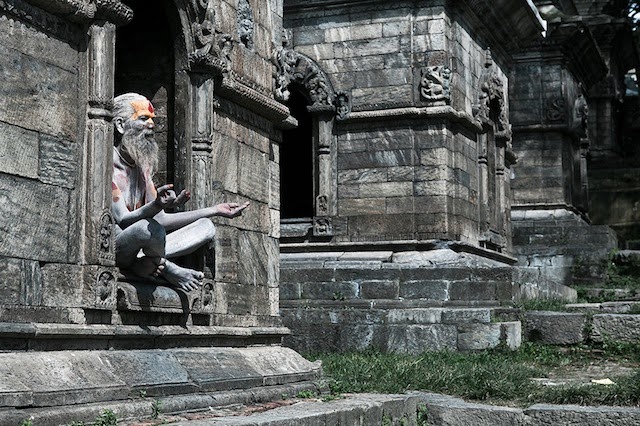
Jeremy Snell | Portraits Of A Sadhu


The staff at Vimeo picked Jeremy Snell's Portraits of a Sadhu, and it garnered over 7,000 views at the time of my writing this post.

The (almost) 3 minutes video introduces us to Rada Baba, a sadhu currently living at the Pashupatinath Temple in Kathmandu. It's the oldest Hindu temple in Kathmandu, and is about 3 miles from Nepal's capital city. Sadhus, such as those shown in Jeremy's video, are common at this temple, especially as it's considered as one of the subcontinent’s four most important Shaiva pilgrimage sites.

It's said that some of these sadhus who are present at Pashupatinath, are members of the Gorakhnath cult, who follow a tantric path, practicing to free themselves of sensual passions and go beyond the attractions of the physical world.

Like Shiva, sadhus use of intoxicants as a so-called path to "spiritual insight". Shiva supposedly discovered the merits of ganja (cannabis), which grows wild in Nepal. They consume the weed in the form of bhang (a liquid preparation) or hashish smoked in a vertical clay pipe known as a chilum.

In a recent post POV: Sadhus, Charlatans or Not, I wrote that I thought most sadhus were a cross between homeless charlatans and spiritual ascetics....but the more difficult question to answer is whether they became ascetics because of poverty or because of some form of inherent spirituality. Charlatanism is an integral part of many of them, but they may have resorted to this activity because of need.

This issue was discussed at some length on my Facebook page. Whether you side with the more plausible view that there are many more fake sadhus than real ascetics, or not, you'll enjoy this short documentary video. I've seen and photographed these sadhus, and I know first hand that they know how to be photogenic. I recall sitting in Durbar Square in Kathmandu, watching two rather flamboyant sadhus, milking tourists who wanted to take their picture. When the light was gone, they hailed a rickshaw...and went home.

Jeremy Snell is a commercial & fine art, portraiture photographer/filmmaker based in Honolulu(Hawaii).

Alexis Pazoumian | Sadhu Hundred

©Alexis Pazoumian-All Rights Reserved


Sadhus...depending on your point of view or experience, they can be spiritual ascetics, devout mystics, philosophic vagabonds, or homeless charlatans. I can say that many of the sadhus I've encountered (and I have met a lot during my countless travels in India) are a bit of all these descriptions, but most are charlatans, preying on the generosity, spirituality and superstition of lay people...many of whom are equally poor. That said, they are photogenic and they know it.

It is estimated there are 4 to 5 million sadhus in India, and these belong to two main sects: the Shaiva sadhus, who are ascetics devoted to Shiva, and Vaishnava sadhus, who are renouncers devoted to Vishnu (including Rama and Krishna). Although some sub sects have properties that generate revenue to sustain members, most sadhus rely on donations, and poverty and hunger are realities for many sadhus.

Alexis Pazoumian's Sadhu Hundred is a photo gallery of sadhu portraits; some of which were photographed at the Pashupatinath Temple located on the banks of the Bagmati River in Kathmandu. It's one of the most significant Hindu temples of Shiva in the world.

You'll note the sadhus following Shiva wear a tilak of three horizontal lines across the forehead, while the tilak of Vaishnava sadhus usually include two or more vertical lines resembling the letter U, which symbolizes Vishnu's foot.

Alexis Pazoumaian is a photographer in France who, after completing a two-year course in a graphics school, turned to photography. He spent six months documenting and living in one of Rio de Janeiro’s favelas,  and was finalist in a contest by “Paris Match” for photojournalism students.

His clients include Agence Elan, Premicefilms, Elie Saab, Maje, Hilldale production, Toshiba, Caviar Agency, We love Art, Monsieur White, Société Général, Maison Sauvage, Grand Palais, Groupe Vendôme, and Agence moderne. 

Drew Doggett | Omo Valley & Slow Road To China

Photo © Drew Doggett-All Rights Reserved

Idly thumbing the pages of a society magazine aimed at the residents on Long Island, I stumbled on an article about Drew Doggett's horse photography, which mentioned that the photographer had trekked in Nepal and Ethiopia.

I visited his website which showcases a couple of Drew's galleries that are a perfect fit to feature on The Travel Photographer blog. The first gallery is Omo: Expressions of a People...which in 2012 was accepted into the Smithsonian African Art Museum’s photographic archives. These monochrome photographs are influenced by the photographer's having trained in fashion photography as an assistant to Steven Klein and Mark Seliger, and is the second of several expeditions Doggett has planned as part of a ten-year project.

Slow Road to China is a photo gallery of the inhabitants and mountains of the Humla region of northwestern Nepal. Also in black and white, these images document a disappearing Tibetan culture.

Photo © Drew Doggett-All Rights Reserved
Humla is considered one of the most remote and isolated regions in Nepal, reachable only by foot or small aircrafts which irregularly land in the district head quarter, Simikot. It is situated high in the Himalaya, in the Karnali Zone bordering the Tibetan Autonomous Region. Its northern part is populated by a Tibetan ethnic group, referred to as Lama in the region.