Showing posts with label festivals. Show all posts

Đạo Mẫu | Serendipity Then Research


One of the main interests that underpins my career as a travel photographer is the documenting of ancient religious rituals, ceremonies and festivals that are still observed and practiced around the world, and the primary objective of many of the photographic expeditions-workshops I lead is to document such rituals and festivals. This interest is somewhat of a brand for me; a brand that I cherish and nourish.

Following my gut instinct, and helped by a degree of serendipity, during my recent photo expedition in Viet Nam, I stumbled on an ancient religious ceremony called Đạo Mẫu, which I photographed on two occasions in Sa Pa and Bac Ha,  and have now uploaded a selection of color photographs on a gallery titled Đạo Mẫu: The Worship of Mother Goddesses.

These photographs were all made with a Fuji X-T1 and a Zeiss Touit 12mm.

Whilst photographing these two ceremonies (one followed the other over two days), I was hampered by a dearth of information regarding these ceremonies. Either the translation was inadequate or the information obtained by those involved in the ceremonies was sparse and superficial...even the name of the rituals differed.

Hearing chants and music coming from the Gia Quoc Cong Vu Van Mat temple in Bac Ha, but finding no one that could understand English, I asked patrons in a nearby restaurant what the ceremony was about, and one finally understood my gesticulations, and told me that it was hầu đồng...words I recognized from my earlier photo-shoot in Sa Pa.

All I knew at the time was that the ceremonies revolved around a medium who communicated with spirits), trances, and religious songs....and I photographed the unfolding ceremony in the Bac Ha temple, as I did earlier in Sa Pa. With other things relating to the photo expedition-workshop on my plate, I hadn't the time to research it deeper than a cursory internet search with the little information I had. Otherwise, I would've sank my teeth in the research like a bull terrier.

I have since started research Đạo Mẫu, or The Worship of Mother Goddesses in Viet Nam, and the rituals of Lên đồng (or Hầu đồng), the practice of spirit mediumship in this type of worship. There are scholarly texts that associate Lên đồng séances to extremely ancient indigenous rituals, which possibly included rites of human sacrifice of mediums possessed by evil spirits.

One of the sources of basic information is Wikipedia, which describes the main ritual, which may last from two to seven hours, as beginning with petitions to Buddha and to the deities for permission to proceed with it, after which the medium sits in the middle of four assistants, whose job it is to facilitate the medium's incarnation of different deities and spirits. Musicians and singers perform invocation songs to induce trances in the medium, at which point he or she is ready to incarnate different spirits. The assistants help the medium to change costumes, and hand over the various props such as swords and torches.

This is precisely what I witnessed during the ceremony (actually, they were two ceremonies back to back) in the Bac Ha temple. The two mediums were flanked by four assistants, and musicians played songs in a corner of the temple.

The color of the medium's four costumes represents a deity who manages a part of the universe. Heaven is red, Earth is yellow, Water is white and Forest is green.

My interest in Đạo Mẫu is certainly piqued, and I intend to continue gathering information on it, online and through friends in Viet Nam. My knowledge of Southeast Asian religious traditions is not as broad as I would've liked, and with Đạo Mẫu serendipitously appearing on my radar, it's certainly time to redress this.

That said, the rituals of Lên đồng (or Hầu đồng) are not easy to photograph. The temples where I witnessed the rehearsal and the ceremony were small, and had devotees sitting on every inch of the floor, so it was difficult to move about and get different angles, especially as the altars are large. The ceremony itself was held at night, with poor and uneven lighting. Although the costumes are gorgeous, with the medium performing unusual rites such as throwing small denominations of cash to attendees, puffing on cigarettes and twirling swords and flags, the rituals are somewhat repetitive, and finding different angles is a must. The mediums appear to be fascinating characters, and would offer interesting insights into this belief system.

In short, Đạo Mẫu is on my list. 
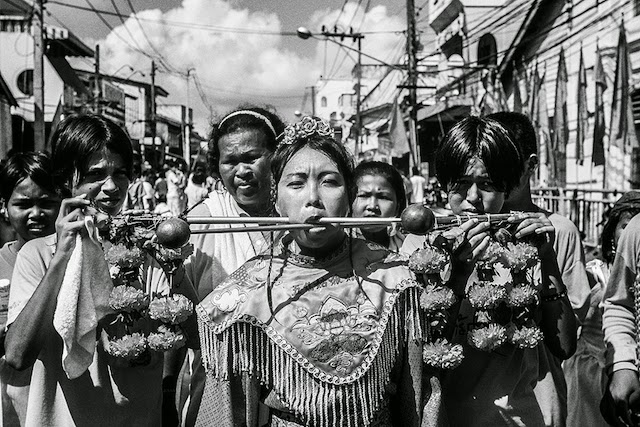
Cedric Arnold | Phuket Vegetarian Festival

Photo © Cedric Arnold-All Rights Reserved
Here's a festival with religious connotations that I ought to add to my list of to do events.

The Phuket Vegetarian Festival is an annual event held in Thailand during the ninth lunar month of the Chinese calendar, and was held  from 24 September - 02 October 2014. It celebrated the Chinese community's belief that abstinence from meat and various stimulants during the ninth lunar month of the Chinese calendar will help them obtain good health, peace of mind, and will also offer spiritual cleansing. Its accompanying sacred rituals grant good fortune on those who observe this rite.

It is thought that the festival was introduced to Phuket by a wandering Chinese opera group who fell ill with malaria while performing on the island.

One of the most exciting aspects of the festival are the ceremonies held to invoke the gods. Firewalking, body piercing and other acts of self mortification undertaken by participants acting as mediums of the gods, have become more spectacular and daring as each year goes by. Men and women puncture their cheeks with various items including knives, skewers and other household items. It is believed that the Chinese gods will protect such persons from harm, and little blood or scarring results from such mutilation acts.

Cedric Arnold's Phuket Vegetarian Festival brings us spectacular monochromatic photographs of this event. Very reminiscent of Thaipusam, the festival includes acts of self mortification that are shocking and gruesome.

Cedric Arnold is a photographer specializing in portraiture, travel, documentary & corporate photography, as well as movie stills. In his personal work, he is often drawn towards exploring the markings of time, this can be in the subject matter itself or expressed with the medium he uses: out of date film, old instant film, or even through chemically altering prints and emulsion.

This is the fourth time that I feature Cedric Arnold's work on this blog. Previous posts can be found here.

Andrea Orioli | Thaipusam

Photo © Andrea Orioli-All Rights Reserved

The Thaipusam ritualistic event occurs 13 kilometres outside the Malaysian capital city, Kuala Lumpur in a sacred Hindu shrine called the Batu Caves.

The festival of Thaipusam was brought to Malaysia in the 1800s, when Indian immigrants started to work on the Malaysian rubber estates and the government offices. The festival is celebrated mostly by the Tamil community, and commemorates the occasion when Parvati gave Murugan a spear to vanquish the evil demon Soorapadam.

On the day of the festival, devotees shave their heads and undertake a pilgrimage along a set route while engaging in various acts of devotion, notably carrying various types of heavy burdens, while others may carry out acts of self mortification by piercing the skin, tongue or cheeks with skewers and sharp hooks.  The devotees perform “Kavadi”, an act of faith where they suffer the pain of dozens of hooks and spears piercing their body during the 272 steps that bring them to the cave temple.

Andrea Orioli photographed Thaipusam, and provides us with yet another view of these not-for-the-faint-of-heart rituals. He is  a biologist working in Switzerland, and has had the good fortune of traveling widely and making photographs. Far more interested in people and cultures than anything else, he's passionate about documenting endangered cultures before they disappear.

He also has featured interesting galleries on his website, including one in Sumba (Indonesia) and another in Kyrgyzstan.

Andy Richter | Kumbh Mela


Photo © Andy Richter-All Rights Reserved
"I wanted to go deeper and connect with the Kumbh from a participant’s point of view. I wanted to see what it was like from the inside, to really experience this massive gathering, and photograph that. It was essential to slow down and spend time with people." -Andy Richter (The Leica Camera Blog)
The Kumbh Mela is the one pilgrimage-festival that seems to really emit a powerful magnetic force, gathering not only Hindu devotees, but all sorts of people including photographers and photojournalists from every corner of the world.  It's one of the world's most extraordinary religious events.

Its main objective is to bathe in the Ganges, as it's said that bathing in sacred rivers during the annual pilgrimage breaks the circle of life & death, and allows Hindus to attain moksha. While attended by millions of authentic pilgrims and devotees, it also attracts an enormous number of charlatans, magicians and fake sadhus who are surrounded by the unwary, the gullible, the curious and naturally, the tourists.

I know this first hand having attended and photographed the 2001 Maha Kumbh Mela in Allahabad, which is reported to have attracted approximately 60 million people, making it the largest gathering in the world at that time.

I am pleased to feature Andy Richter's Maha Kumbh Mela, which was mostly photographed with a Leica M9 with a 35 mm Summilux. One of his essay's photographs shows a mass of pilgrims crossing a pontoon bridge, where I also walked, and I still recall the sensation of being shoulder to shoulder with this moving mass of humanity, giving me the impression I was standing on a flat escalator.

Andy tells a fine story on The Leica Camera Blog, and mentions how he was surrounded by the naked babas bathing in the river...and meeting Alex Webb at the same spot.

The Birth of Color | When Krishna Met Radhe


I'm pleased to feature my photo essay titled The Birth of Color-When Krishna Met Radhe with more than 20 "full-bleed" color photographs of the festival of Holi in Vrindavan and Mathura. I chose to publish this 'sampling' of photographs on Exposure, one of the photo-narrative portals that is designed to give photographers space to publish photo essays. Some of these images and others will also be published on my website.

These photographs were made during my recent The Sacred Cities Photo Expedition-Workshop to Varanasi and Vrindavan. We spent around a week photographing the festivities of Holi in Mathura and Vrindavan and in retrospect, it was one of the most difficult photo expeditions-workshops to operate due to the chaotic nature of the festival, and other factors which I address in more details here.

Part of the title to this photo essay is obviously inspired by the movie When Harry Met Sally...an iconic movie if there was ever one. There's no direct link with the movie's story, but I thought it was a catchy title. In fact, the festival of Holi is based on a number of legends; only one of which is based on the love story between Krishna and Radhe.

Producing an audio-slideshow of Holi is quite difficult because of the disparate events that took place whilst we were there. Particularly difficult is the editing that will have to go into producing a coherent audio track.

Photo © Charlotte Rush-Bailey-All Rights Reserved

Seeing the imagery I returned with, I now think whatever happened to me: getting whacked on the elbow by stick-wielding out-women during one of Holi's 'rituals', getting smothered with color powder or doused with colored water, was really worth the trouble.


Theyyam: Incarnate Deities | Maptia


I'm very pleased that Theyyam: Incarnate Deities, one of my most colorful photo essays, is now featured on Maptia.

A beautiful way to tell stories about places, Maptia is a new platform designed for thoughtful, inspiring stories that make us want to get out there and explore the world, and each story has its own unique map.

It's different from the crop of photo/storytelling platforms that have recently appeared, inasmuch as it makes easy for people and story tellers to share long-form stories about the places that matter to them, and by creating unique, visual maps of these stories.

In an interview with WIRED some 6 months ago, Maptia's founders indicated that the platform already had a community of 10,000 bloggers, photographers, and writers.

Theyyam is a popular ritual form of worship of North Malabar in the state of Kerala (India), and is essentially a living cult with several thousand-year-old traditions, rituals and customs. 

In his book, Nine Lives, William Dalrymple wrote about the Theyyam. One of the stories, "The Dancer of Kannur", is of one of the Theyyam performers who's quoted as saying:
"...during the theyyam season, from December to February. We give up our jobs and become theyyam artists. For those months, we become gods. Though we are all Dalits (untouchables) even the most bigoted and casteist Namboodiri Brahmins worship us, and queue up to touch our feet."
The Theyyam prepares for his performance by meditating while his make up is applied, which usually takes a few hours. When it's ready and totally dry, he views himself in a hand mirror, and then enters in a sort of a trance, whereupon he walks (aided by assistants) over to the temple's shrine and gradually morphs into the shrine's deity. The Theyyam dances to the accompanying drum beat,  and goes deeper into his trance. At the appropriate time, the Theyyam is seated on a stool and devotees approach him with donations and solicit advice, which he provides in a raspy voice. I was also told that the Theyyams' advice is provided in a mixture of Sanskrit, Old Malayalam and Tamil. Both Theyyams and Kathakali performers use similar eye movements to convey emotions.

Semana Santa | Reuters' Full Focus

Photo © REUTERS/Marcelo del Pozo-All Rights Reserved
Try to say the following in one go...without pausing to take your breath.

"Holy Week is the week preceding Easter and the final week of Lent. Holy Week begins with Palm Sunday and ends with Holy Saturday, the day before Easter Sunday. Holy Week includes Holy Thursday (also known as Maundy Thursday) and Good Friday, which, together with Holy Saturday, are known as the Triduum. Before the revision of the liturgical calendar in 1969, Holy Week was the second week of Passiontide; in the current calendar, Passiontide is synonymous with Holy Week."

Out of breath and confused? That's okay.

Reuters Full Focus has two dozen photographs of the Holy Week, which are worth you stopping by. Most of the remaining photo bogs will sooner or later feature photographs of this week long event, but Reuters was the first.

I have a travel photography bucket list, and the Semana Santa event in Seville is certainly on it. This event is one of the important traditional events of the city, and is celebrated in the week leading up to Easter. The week features the procession of floats of lifelike wooden sculptures of individual scenes of the events of the Passion, or images of the Virgin Mary showing grief. Some of the sculptures are ancient, and are revered.

Photo © Tewfic El-Sawy-All Rights Reserved

I attended a Semana Santa in La Antigua (Guatemala), and it was quite an experience. Although small, it featured some rituals indigenous to this Central American nation, which included covering streets of La Antigua with natural, aromatic carpets of flowers, pines, clover and fruits, which the residents made and placed in front of their homes.

I'm interested in the Spanish observances during Holy Week, especially in the smaller towns and villages where one can see processions of hooded flagellants in chains and performing self mortifications...and this is on the bucket list.

Nyepi | The Atlantic's In Focus

Photo © Agung Parameswara/Getty Images-All Rights Reserved
The Atlantic's In Focus (which, in my long held view, is the best photography blog of all the major news media) has recently published a gallery featuring 27 photographs of Nyepi.

Every year, the Indonesian island of Bali celebrates Nyepi, the Balinese New Year's Day. Nyepi is a day of silence, and is dedicated to self-reflection. It's the day when people (Balinese Hindus and tourists) stay home and are not allowed to use lights, start fires, work, travel or enjoy entertainment. There is little or no noise from TVs and radios, and few signs of activity are seen even inside homes.

However, the days surrounding Nyepi are anything but silent - several rituals of offering and cleansing take place before and after New Year's Day, to rid worshipers of past evils and bestow good fortune in the year ahead.

I haven't been to Bali during Nyepi, but I attended a number of Melasti rituals which start off Nyepi, but are also frequently held all though the year.  A Melasti ritual is performed near the sea, and is intended to purify various sacred icons belonging to several temples. During the festival, sacred purifying water is obtained from the sea.

Photo © Tewfic El-Sawy-All Rights Reserved
In the above photograph, I photographed a Melasti in Bali during which a number of women (and men) lost conciousness and went into short trances. The one above was particularly interesting because it coincided when the sacred water from the sea was brought onshore in a large bottle (seen on the left under the white umbrella). 

Thaipusam | Yeo Kai Wen


Here's an interesting and compelling photo essay on Thaipusam, the Hindu festival celebrated mostly by the Tamil community during January or February. It's mainly observed in countries where there is a significant presence of Tamil community such as India, Sri Lanka, Malaysia, Mauritius Singapore, Indonesia, Thailand and Myanmar.

This particular series of monochrome photographs were made during Thaipusam at Sri Thendayuthapani Temple in Singapore, by Yeo Kai Wen and was featured by Exposure.

It's unusual to see Thaipusam photographs in black and white as it's a colorful festival, with devotees shaving their heads and undertaking a pilgrimage along a set route while carrying out various acts of devotion, which may include self-mortification by piercing the skin, tongue or cheeks with skewers.

The photographer, Yeo Kai Wen graduated from the School of Film and Media Studies with a Diploma in Mass Communications in 2009, and is now specializing in documentary production, print and photojournalism.

Exposure is a storytelling platform specifically created for photo sets which are described as 'narratives'. It appears to have an extremely simple and easy to use editor that lets you drag and drop photos into your browser, and then add headers, body text and captions between photos. The posts feature full-bleed images and imaginative fonts and white space. Three Exposure posts are free, but for unlimited posting, custom domains, password-protected posts, and more, one has to shell out either $5 or $10/month, depending on the package chosen.

Vrindavan In Monochrome

Photo © Tewfic El-Sawy-All Rights Reserved
Having been through almost two weeks of explosive over-saturated colors, I thought it time to work in monochrome.

Vrindavan In Monochrome (or Radhe Radhe) is a gallery of black and white photographs...perhaps an antithesis to the explosive colors of the Holi festival, and is of pilgrims, devotees and dwellers of this holy and sacred city…going along their daily routine.

Whether the widows near their ashrams, the Bengali pilgrims bathing in the Yamuna river and drying their clothes, the Hare Krishna devotees on their daily yatra circling Vrindavan, elderly dwellers basking in the sun or the spiritual “guides” taking the hordes of pilgrims around its thousands of temples…these photographs depict a sliver of what goes on in the holy city on a daily basis…even during Holi.

I didn't take my M9 with me to India this time, and I quite missed it whilst making this type of photography. Some of the photographs in this gallery were made using spot metering and manual settings to cast much of the subject in shadows, and with just traces of light on them. The light during the day in India can be harsh, but we were blessed with a thick fog/mist when walking along a stretch of the yatra, or pilgrim route around Vrindavan.

Photo © Tewfic El-Sawy-All Rights Reserved
Radhe! Radhe! is the customary greeting exchanged in Vrindavan during Holi...or perhaps it's exchanged all the time. Radhe is Krishna's consort, his main gopi and is regarded as the incarnation of the Goddess Lakshmi.

Arindam Mukherjee | Lathmar Holi

Photo © Arindam Mukherjee- All Rights Reserved-Courtesy Al Jazeera
Yes, I know. We might all be Holi'ed out by now, however Arindam Mukherjee had sent me a link to his work while in Vrindavan, and I just couldn't get my web browser to cooperate and get the Al Jazeera In Pictures website to open.

Many of Arindam's photographs were made during Lathmar Holi in Barsana. This is where we (because of a scheduling change) arrived at its peak, instead of a few hours ahead of it which would have given us enough time to case the area and choose our shooting spots. As it happened, we had to slowly shove our way through the dense crowd (see the fourth photograph down), and one of our group members' pockets were picked, and he was relieved of a small amount of cash.

And try as hard as I could, I was never able to find any hijras (as the one shown in Arindam's lovely photograph above) celebrating Holi during our stay in Vrindavan. I did meet a group of them watching the chariot procession in Mathura, but they were waiting to perform at a wedding or some other venue later in the evening. One of these transgenders sported a lush goatee...which seemed rather incongruous.

Holi, whether in Mathura, Vrindavan or elsewhere, was very well covered by local photojournalists/photographers...some freelance, and others affiliated with news organizations...and whenever I met them, were quite helpful in sharing some information.

The dearth of accurate and reliable information (the start and end of the various events, as an example) made it very difficult for us, but there was nothing we could do about it....except hope and pray.

Holi In Mathura | Phil Gribbon | Maptia

Photo © Phil Gribbon- Courtesy Maptia
What a coincidence!

I got an email from the co-founder of Maptia inquiring whether I'd be interested in having one of my photo stories featured on this new (started in September) platform that aggregates travel stories, and founded by two young entrepreneurs with a desire to build "the most inspirational map in the world."

Realizing I was virtually on my way to India on my The Sacred Cities Photo Expedition-Workshop, and to document Holi in Mathura and Vrindavan,  the discussion was to be postponed until I returned, but in the meantime, I was guided to a photo essay-story authored by Phil Gribbon, a photographer based in Cairo (another coincidence!) titled Holi In Mathura featured on Maptia.

"My traveller friends had had enough paint-throwing (the girls especially had had enough over-enthusiastic strangers rubbing them in odd places) and so skipped the excursion."


The accompanying text as penned by the photographer is highly amusing, self deprecating in parts and very witty all through. Most of Gribbon's 43 photographs seem to have been processed as if they were passed through an Instagram-like filter, and were geographically tagged as having been made in Baldeo, a town in Mathura. These are larger sized on his own website.

I've read that he arrived in Mathura, wanting to photograph this incredibly colorful festival but was not entirely ready to face the 'exuberance' of Holi. He quickly wised up and and as he says it, he wrapped his camera in plastic and gaffer tape and went for a walk through the streets nearby.

This is my last regular blog post for a while. I will post as much as I can possibly can during the coming two+ weeks, keeping my readers appraised of developments and progress during the photo expedition-workshop.

Chehlum (40 Days After Ashura) | GrayScale


One of the religious rites I'd like to attend to photograph is Ashura, which is the Shi'a Muslims' commemoration of the martyrdom of Hussein ibn Ali, the grandson of the Prophet Muhammad in 680. I've been thinking about it for a while, and having featured various posts about it on this blog made the itch worse.

The most logical place to witness and photograph the event is certainly in Iran or Iraq, but with a US passport it may be more advisable for me to attend the event in other countries. One that obviously springs to mind is India, where large swaths of Shias live in the cities of Hyderabad and Lucknow.

There's also the ritual of Arba'een which follows Ashura by 40 days, and is considered as one of the largest pilgrimage gatherings in Karbala in Iraq. Arba'een is the Arabic word for 40, and it's the traditional length of the time of mourning in many Islamic cultures.

Chehlom is the Persian word for the "fortieth" day, which is what the event is called in Pakistan where this brand new short cinematic montage was made.

It was produced by GrayScale, an all service Television & Film Production Company based in Karachi, Pakistan with bureaus and satellite offices in the cities of Peshawar, Islamabad and Lahore.

It can also be viewed on Vimeo.

Faith Connections | Pan Nalin


So much has been written, photographed, filmed, spoken of the various Kumbh Melas...to the point that, with a few exceptions, I've become somewhat blasé about this monumental religious event. In fact, when I'm asked if I'd consider leading a photo expedition-workshop to a Kumbh Mela, I can barely stifle a yawn or even worse, an eye-roll.

However, Faith Connections, Pan Nalin's trailer of the Kumbh Mela, re-ignites the spark of interest that is shared by many to document the event.

Pan Nalin is an Indian film director, screenwriter and documentary maker, and is best known for directing award-winning films like Samsara, Valley of Flowers, and Ayurveda: Art of Being. He traveled to the Kumbh Mela, one of the world's most extraordinary religious events. He meets remarkable men of mind and meditation, some facing an inextricable dilemma; to embrace the world or to renounce it. 

The above trailer is also connected to a splendid website Faith Connections, which provides links to a few stories from the Kumbh Mela. You'll view and read the stories of a young runaway kid, a sadhu, a mother desperately looking for her lost son, a yogi who is raising an abandoned baby, and an ascetic who smokes cannabis.

This is highly recommended to those who've never been to a Kumbh, and to those who've been once or more.

Holi By Variable


In anticipation of documenting the exuberant Holi festivities in Vrindavan and Mathura during my forthcoming The Sacred Cities Expedition-Workshop, this short trailer-like movie will captivate you (and my fellow group members) with its splendid videography, colors and slow-motion effects.

The film makers behind the video are Tyler Ginter, Khalid Mohtaseb, Jonathan Bregel, and Nick Midwig using Rule Boston Camera’s Phantom Flex...and they are part of WeAreVariable, a collective and production company based in New York City.

I'm certain that readers of this blog know the Indian festival of Holi which is celebrated on the day after the full moon in early March every year, but here's a summary of what it's all about.

Holi's origins lie in the celebration of plentiful harvests and fertility of the land, but is currently more of a commemoration of a legend from Hindu mythology. The festival is mostly associated with the immortal love of Krishna and Radha, and is accordingly observed with uncommon fervor in Vrindavan and Mathura - the two cities with which Krishna was raised and has affiliations.  Colored powder (known as gulal) and water, festive processions, folk songs, dances mark the celebration of Holi in these cities.

With about two months to go until our group is in Vrindavan/Mathura, discussion are already under way as to how best to protect our photographic gear from the effects of colored water and powder. Various alternatives have been debated, and experimentation with these alternatives has already started.  

Chico Sanchez | Day of the Dead In Oaxaca

Photo © Chico Sanchez-All Rights Reserved
At the beginning of November, Mexican families invite the dead over for dinner. While the Dia de los Muertos (or Day of the Dead) is close enough to Halloween to be confused with it, and be all about ghouls and goblins, it's not.

It's about honoring the dead, and about blessing of souls. Nowhere is this observance celebrated as it is in Oaxaca, to which locals and tourists flock to participate in its rituals. This observance goes back some 3000 years, way before the Spanish conquistadors arrived in the region. It evolved during the years, and its current festival is a mix of pre-Columbian customs and Christian teachings. The Aztecs believed that life and death coexist, and during the Day of the Dead, the dead can visit the living.

Coming Back Home is an audio slideshow produced by Chico Sanchez who's just returned from Oaxaca, photographing the scenes and rituals on its November 1 Day of the Dead. It features narrative, an interview and the music of local bands.

I've featured the work of Chico Sanchez, a freelance photographer based in Mexico City, on a number of occasions. He was born in southern Spain and moved to Latin America in 2001 when he started working with Reuters in Venezuela. He collaborated with the European Press Photoagency, Agencia EFE, and freelanced for various newspapers and magazines. He currently focuses on stock photography, producing audio-slide shows and freelancing.

Tony Smith | Pèlerinage Des Gitanes

Photo © Tony Smith-All Rights Reserved

Here's another photographic essay in an audio-slideshow format documenting the gypsy pilgrimage, an annual event held in Saintes Maries de la Mer, a small village in the heart of the Camargue, South of France. Tony's photography, his narration plus the unusual music of the gypsies during the festival are certain to interest viewers in a lesser known religious festival held in the very heart of Europe...and which has its roots in the Middle East and South Asia.

This time it's by Tony Smith, a Welsh born photographer who specializes in photographing ethnic, cultural and religious festivals and environmental portraiture.

On May 24 of each year, more than 10,000 travelers (including Roma, gypsies etc) come from all over Europe to Saintes Maries de la Mer to venerate their patron saint Sara the Black (also known as Sara la Kali), and take the opportunity of having their children baptized during the festival.

In my previous post about this particular pilgrimage/festival, I mentioned that I was struck by the similarities between this gypsy religious festival and those of West Bengal's Durga Puja and the odalans (temple anniversaries) in Bali.  It's also curious to learn that the nickname given to the gypsies' patron saint is Sara la Kali. Kali is the Hindu goddess associated with empowerment, time and change., and the name Kali comes from kāla, which means black.

This is most interesting as the Romani originated from India and arrived in Europe by the 14th century, and the Kali name given to their patron saint could have its origin as theirs.

Tony provides more information on the festival in his own words (with some redaction):

"The main pilgrimage is held in May every year. This is when the town is besieged by thousands of Gitanes from France, some Gitanos from Spain and other Roma from once Eastern Europe, Hungary, Romania, etc. The people of the area, in national costume, also participate in the processions though it is not their event. The same can be said for the gardians, the Camargue cowboys who seem to police the event by leading the processions. The music (accompanying the slideshow) is an evolved mix, and coming out of Eastern Europe will no doubt have some Yiddish violin in there somewhere. For anyone thinking of going who might be worried about security, don't be. It's primarily a religious festival and I have not seen a single incident there."

Tony attended my 2011 Kolkata's Cult of Durga Photo Expedition/Workshopwhich was principally aimed at documenting the annual West Bengali religious event over the course of almost 2 weeks.

Viviana Peretti | Camargue Gypsy Pilgrimage

Photo © Viviana Peretti-All Rights Reserved
I sometimes discover a photographer's work that is so interesting that I hurry to post about it as soon as possible, upending the predetermined order of future posts on my blog.

The work of Viviana Peretti is one of those.

So I'm glad to feature Viviana's Gypsy Pilgrimage in La Camargue which she covered so well using her iPhone and the Hispstamatic's Tintype Tinto 1884 lens and the D-Type film pack...which is by far my favorite.

The Gypsy Pilgrimage celebrate the saints Mary-Jacobé and Mary-Salomé, and it is held in Saintes Maries de la Mer, a small village in the heart of the Camargue, South of France. The legend is that a boat landed near the village's site from Palestine, carrying Mary Magdalene, Marie-Jacobé, and Salomé, as well as Lazarus. With them was Sara, whose identity is unclear. There are some who believe that she was the daughter of Mary Magdalene and Jesus Christ...while others believe she was the personal maid of Marie-Jacobé. As the only dark-skinned woman on the boat, she was embraced by the Romani as their patron saint.

Romani (aka gypsies) from the region carry the the saints' effigies in a long procession to the beach to be blessed in the sea. The procession is not only made of Romani, but of the region's Arlesiennes in their distinctive costume, as well are the Gardians (Camargue's cowboys) and pilgrims.

This ritual's concept reminds me of the Hindu Durga Puja and the Balinese odalan, where effigies are carried to the river or sea to be blessed.

Viviana Peretti is an Italian freelance photographer currently based in Europe. After earning a BA in Anthropology from the University of Rome, she moved to Colombia where she specialized in photojournalism and worked as a freelance photographer for 9 years. In 2010, she graduated in Documentary Photography and Photojournalism from the International Center of Photography, and worked in NYC as a freelance photographer until her recent move to Europe.

She received fellowships and awards from the International Center of Photography, the Joannie M. Chen Fund in New York, the University of Salamanca, the Spanish Embassy in Colombia, the Photo Museum in Bogotá, and the Colombian Ministry of Culture. In 2010, she was selected for the Eddie Adams Workshop (Barnstorm XXIII), and has been published in a number of international newspapers and magazines including The New York Times, the New York Magazine, BBC, CNN, Le Journal de la Photographie and L'Espresso.

John Horniblow | Imilchil Wedding Festival


The Imilchil moussem (festival) is held in Morocco's High Atlas, and is all about livestock and finding a partner. It's also known as Souk Aamor Agdoud N’Oulmghenni, which is a tongue-twister for most of non Berber speakers. It represents the annual meeting of the large and important tribal Berber families of Aït Haddidou, Aït Morghad, Aït Izdeg and Aït Yahia.


There are two versions of stories explaining the birth of the festival. The Berber version tells the legend of two young people from different feuding tribes who fell in love but akin to Romeo and Juliet, they were forbidden to see each other by their families. The grief of unrequited love led them to their deaths. The legend tells that they cried themselves to death, creating the neighboring deep alpine lakes of Isli (his) and Tislit (hers), near Imilchil.


Another version is that the lovers drowned themselves in the separate lakes. The Imilchil Marriage Festival was founded as a commemoration of the lovers' death, and provides the opportunity to unmarried Berbers, particularly women trapped at altitude for most of the year, to look over and mingle with prospective spouses. They sing, dance and flirt, and available men must wear white turbans and their female opposites wear the family silver.


Another version, but much less romantic explanation, is that Morocco's French past colonial administrators assembled the transitory Berbers to register their births, deaths and marriages.

John Horniblow tells us "small groups of young Berber women dressed in traditional finery and roughly, woven woollen robes distinctive to each family tribe, some with berber fibules (amulets), eyes rimmed with heavy black kohl, and intricately hennaed hands, amble through the commerce of the souk talking, flirting with or being approached by the potential bachelors trying to strike up meaningful conversation. The wary eyes of elder relatives, looking on, following them protectively at a furtive distance."

John Horniblow is the founder and editor of Photojournale and publisher of Photojournale Connections Across A Human Planet. John is both photographer and film maker with his photographic work featuring in Geo Mundo, Penguin books and People ( Time Inc.) . He also has worked on production managing and assisting Frans Lanting on assignment with National Geographic and has also produced directed and shot documentary and short films featuring on SBSTV , Channel Seven and at International Film Festivals.

Ninth Angkor Photo Festival 2013


The 9th Angkor Photo Festival is scheduled for November 23-30, in Siem Reap, Cambodia.It's longest-running international photography festival in Southeast Asia, will showcase the work of over 130 photographers, half of which are from Asia.

The week-long event will feature daily evening outdoor slideshow projections as well as 8 indoor and outdoor print exhibitions.

The 2013 Program is curated by the festival's program coordinator, Françoise Callier. In addition, Shahidul Alam (Director of Chobi Mela - Bangladesh) and Jean François Leroy (Director of Visa pour l’Image – France) will be its guest curators.

Some of the photographers who will showcase their work are Edwin Koo, Marylise Vigneau, John Vink, Patrick Aventurier, Kumi Takahashi, Gali Tibbon, Sankar Sarkar, Dina Oganova, Binh Dang, Abir Abdulla, Subrata Biswas, Antoine Raab and many others.

I was privileged to attend the Angkor Photo Festival in November 2011 and one of my photo essays The Possessed of Mira Datar was featured at the festival. It was an absolute delightful experience to be part of such an event, and the gracious hospitality of Francoise Callier and Jean-Yves Navel (the Festival Director) was instrumental in making it such success. I have no doubt that the festival in November 2013 will equally be as wonderful.